 |
 The SpaceWriter's Ramblings |
|
||


|
|
|
||
|
Anything and everything about science, especially astronomy and the cosmos. NOTE: This blog has migrated to a new address. Please update your favorites link accordingly.Visit my web site at Posting times are Powered by
|
8.29.2003 Enchanted Skies
Dave Finley (public affairs officer for the National Radio Astronomy Observatory) gives a fireside talk during the 2002 Enchanted Skies Star Party. Copyright 2002, Carolyn Collins Petersen Last year we took our vacation in New Mexico. Along with hiking around Chaco Canyon, we decided to attend the Enchanted Skies Star Party, held each year in Socorro (about 70 miles south of Albuquerque). This is one of the most laid-back amateur astronomy get-togethers in the U.S. I almost hate to give it more publicity because I don't want to see it become a huge thronging mass of people — but my more noble side wins out because I think it's a great opportunity for folks to travel to a dark-sky site, hear some great talks, and see some great skies!
I've been to ESSP four or five times now and each time is a great experience. Twice I was offered the opportunity to give a science lecture, and the other times I just went for the sheer joy of it all. The lectures are all given at the New Mexico Tech campus and range from "getting started" type talks to presentations from astronomers about the latest in "Big Science." The stargazing part of the party is divided up between the campus observatory and a ranch area about 20 miles out of town. In both cases, the skies are wonderful and the stargazing is a lot of fun.
The Saturday night barbecue and sing-along under the stars is a big hit. Last year we stayed out until about midnight before heading back to the hotel, but many folks lingered on until the very wee hours, sucking in that big, dark, wonderful sky. If you're looking for something to do that's different, gets you to someplace you haven't been before, and want some sublime memories of scenery and dark sky, this is the star party for you. I just got a mailing from the organizers and it looks like this year's meeting will be as great as 2002's was! Check it out!
8.28.2003 Mars Mania, Part NIn an earlier entry I alluded to the fruit loops who come out of the woodwork whenever there's an astronomy-related event that could be exploited for some sort of new-agey gain. Today on CNN I read that sooth-sayers around the world are claiming Mars's influence on Earth means something bad will happen in America very soon. As the teen-agers like to say, "Wull duh... "
Chances are with a prediction that broad, when tomorrow's news from the U.S. comes on the TV, these mystic gurus will throw their hands up in glee and say, "See, I told you so... " (with the unspoken line being: "now give me your money or your soul (or both)"). Well, you have to laugh — these folks have found a lovely way to get followers (and presumably money and fame and sex and whatever else it is they want) by exploiting naturally occurring events in the sky. It's lovely work, but is it quite honest? Good question. Think about it the next time you're out there looking at the stars... posted by CCP on 8/28/2003 02:20:00 PM | *
8.25.2003 MARS!!If you haven't gone out to see Mars yet — and the weather is clear in your area — get outside sometime after 10:30 or 11 the next few nights and look! It's great! It's that reddish point of light high in the southern sky (for northern hemisphere viewers). We went viewing it over at Oak Ridge Observatory on Saturday night — saw it through a 61" telescope, a 6.5" scope, and a 16" scope -- but it's just as enchanting to look at through the naked eye and your imagination to take you to the ruddy surface of the Red Planet. Go!!!
Does This Telescope Make My Ass Look Too Big?A long time ago — in the dark ages — amateur astronomy was pretty much thought to be a male domain. The telescope magazines used to show pictures of telescopes with pretty girls standing next to them. Sort of like the geek's equivalent to the hot car with the half-nekkid babe draped over the hood -- sort of like this one I found over at Scope Reviews.com.
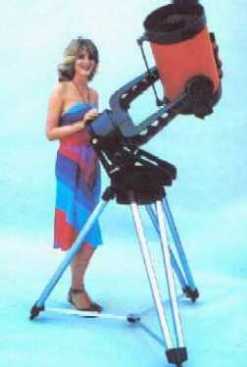
Pretty stupid when you think about it — that attitude that some dish was going to go out stargazing lugging that light bucket around all dolled up in heels and a dress. So, things have changed today, right? Well, sure. There's change and then there's change. We see a lot more women at star parties (and a lot more females in Big Astronomy). A lot of them have some pretty cool scopes. The astronomy ads are likely to show just the scopes these days, without the need for eye candy. So that's all cool.
But there are still some strange attitudes out there about women doing astronomy. I like to read sci.astro.amateur on Usenet — and most of the folks on there are as nice and welcoming as you'd ever imagine. But occasionally there'll be some discussion about how to get "the wife" to allow more eyepiece purchases, or "what do I do if my wife isn't interested in astronomy?" which then lead to some strange, sexist commentary in the replies. One memorable exchange a few years ago had a guy wondering out loud in a message about building his wife a telescope and painting it pink so she'd get more interested in the hobby. Reminded me of those silly pink-handled tool sets that come out every year in time for Mother's Day. These folks never figure out that making something pink doesn't make it any more useful for a woman than it would be for a man.
Sometimes when I read these message I think of a bunch of little boys in a treehouse somewhere, arguing about how to keep the "gurls" out.
So, what do they think women astronomers worry about when we're out stargazing? Getting our eye shadow on the viewfinder? Color-coordinating our shoes with our battery-operated socks? Whether or not a 6" Dob or a 8" newtonian will make her hips look too big?
Tell you a secret: we're astronomers. We like to look at things through the scope when the spirit moves us -- just like the guys do. We buy eyepieces. We polish our mirrors. We swear at the damned tracking motor when it doesn't track right. We bitch about the seeing and whine about the mosquitos and no-see-ums just like the big boys. And when everything comes together on a perfect evening, we're moved by the beauty we see in the skies.
So, let's hear it for skygazers and let's forget about whether they're XX or XY. Besides, lugging around a huge telescope is bound to make your ass feel tired before it feels big... posted by CCP on 8/25/2003 07:50:00 PM | *
8.07.2003 Clouds!We've been looking at a lot of cloud bottoms lately. Today they're about to drop water on us, and I'm hoping they'll clear up before tonight so I can look at Mars. But what do you do when you're rained out and still want to enjoy some astronomy?
I like to read astronomy books. There is a stack of them in my office, waiting to be read. Things with titles like "Handbook of Infrared Astronomy" because I always wanted to understand how IR folks do their thing. There's also Deep-Sky Wonders" -- a book I edited for Sky Publishing, back when I was a books and products editor. Actually amateur observer Steve O'Meara was the first editor on the book, which is a compilation of the best and coolest columns by long-time Sky & Telescope columnist Walter Scott Houston. It came across my desk for final editing and fact checking and I spent many months poring over the words before they went to press. Then for about a year I couldn't bear to look at the book because I was too close to it. Now, more recently though, I've been taking it down off the shelf and reading about starhopping from the Big Dipper or galaxy hunting in Corona Borealis, or other such little goodies that are forever enshrined in the book. It's good armchair astronomy, especially when the cloud bottoms get to be too much.
Occasionally I get off on a science fiction jag, reading back issues of Analog or Isaac Asimov's Science Fiction Magazine to pass the time. Or, if I'm really bored, there's also Web surfing for cool astronomy pictures!
But if you're not into reading or Web surfing is getting old, what else can you do? Some folks have the full Cosmos TV series, first broadcast on public television in the early 1980s. That's a great one to watch, particularly if you're faced with a string of foggy, cloudy nights. You learn a lot from Carl Sagan's exploration of the universe in that series, and it does keep you going until the next sucker hole in the clouds opens up and welcomes you back to an evening of stargazing! posted by CCP on 8/07/2003 02:32:00 PM | *
8.06.2003 Astronomy and the Lunatic FringeWhat is it about stargazing that draws so many fruitloops out of the closet? I've often wondered this while scanning the sky looking for my favorite objects. There's something so intrinsically beautiful about the stars and planets. They're just there being stars and planets. Most stars shine by consuming hydrogen fuel in their cores and venting the energy generated as light. Planets reflect the light of the Sun, and they orbit the Sun in predictable paths. So, why is it these predictable, physical motions and activities draw out what a friend of mine often refers to as the "psychoceramics" experts? (translation: crackpots) I'll be darned if I know for sure, but my guess is that there's an innate human need for the mysterious — and since the stars and planets can't be touched (easily), they're good candidates for fuzzy applications of the mysterious and arcane. Take Mars, for example. It orbits the Sun every 687 days, almost but not quite twice as long as it takes Earth to go once around the Sun. Both planets go round and round, like two kids on a merry-go-round. One planetary kid is on the inner circle, the other is on an outer circle. Every 17 years or so, the two planets end up near each other in their orbits; Mars looks big and bright in our sky, and if somebody on Mars could see us (and Earth wasn't lost in the glare of the Sun), we'd look pretty bright and big in their sky, too. This is an entirely predictable, natural consequence of planets in orbit around a star. This summer a huge number of amateur astronomers (and a bunch of professionals, too!) are aiming their telescopes at Mars and taking this opportunity to study the Red Planet in detail. They're all quite dedicated to the scientific study of the planet and they're capable of turning out some amazing work.
This is an image that Don Parker — a member of the Association of Lunar and Planetary Observers (and one of the funniest guys I've ever met) -- has taken of Mars this summer. (You can see more Mars photos at: The ALPO web site. Now, the amateur and professional astronomers aren't the confused types I was referring to in my opening sentence. No, the folks I'm thinking of are whipping themselves into hysteria over this perihelic opposition of Mars (that's what it's officially called). And they aren't likely to be outside actually observing the planet. Why let reality stand in the way of a good fantasy? One "PhD" in astrology (no, I'm not mentioning any names — why give him/her free publicity?) is claiming that Mars's energy signature in one's horoscope could be causing people to be upset, overworked, suffering from ego-inflation, and engaging in fault-finding of one's fellow workers or family members this summer. Gosh, do ya really think so??? Of course it HAS to be Mars, rather than — say, the recent spate of hot weather in many parts of the world. Nobody would blame personality glitches and short tempers on anything logical when a planet some 55 million kilometers away is a much more convenient source of bad karma. Right? Of course not. That wouldn't be profitable. A little word of advice here — astronomy's a great science. It's one you can do for yourself. And it's one you can learn for yourself. You don't need a mystic guru to read your tea leaves or use psychoceramic powers to interpret the Martian movements for you (all for a fee). Sure, you might need help from a friendly observer or a few finder charts from someplace helpful like SkyandTelescope.com — but they're just there to help. Not do your thinking for you. Step out there one of these summer nights around midnight and check out the stars and planets. Mars will be the one shining in the south east (if you're in the Northern Hemisphere), and it's reddish white! No special tools required to see it!
Stargazing and Burnt OfferingsThe draw of stargazing is hard to describe. Sometimes you don't even know you want to stargaze and then you step outside and there they are -- gorgeous stars twinkling away in the darkness. This is particularly true on cold winter nights in the Northern Hemisphere when the last thing you're interested in is freezing your buns off in the snow while trying to spot some deep-sky object through a rapidly cooling telescope. (For viewers in the Southern Hemisphere, it may not be so cold unless you live at altitude.) But one glimpse of Orion through the kitchen window is enough to send me out there -- at least for a little while.
Summertime is different. Theoretically you're supposed to be able to go out there, lie on the grass with pair of binoculars and take in the sights. Well... maybe. It can be a challenge, especially if you share your stargazing site with a couple of million insects.
Where I live it's not the cold weather that keeps me indoors on clear summer nights. It's the mosquito population. We have a burgeoning supply of these bloodsuckers, and it's tough sometimes to fight them off. A couple of summers ago we went down to Florida with some other skywatchers to observe Mars from lower latitudes and see if we could spot a phenomenon called the "Mars flash." This occurs when the Sun, Mars and Earth are roughly aligned (like during opposition) and you can (theoretically) see sunlight glinting off ice particles on Mars's surface. We did manage to catch a glimpse of the flash, but we also came home with patches of skin ridden with bites from mosquitoes and tiny bugs called "no see ums." No amount of DEET-laden stuff could ward them all off. Once we got home I set up my telescope in the backyard so I could continue watching Mars. But, mindful of the bugs, I sprayed myself diligently and resorted to burning these repellent-enhanced spirals called "mosquito coils."
There I was, aiming my telescope at a tiny red dot in the sky, smelling of DEET, and surrounded by multiple coils smoking away around me, theoretically keeping the industrial-strength mosquitoes away from me. I often wonder what our new neighbors would have thought about if they'd seen me out there, surrounded by burnt offerings like some goddess in an ancient temple. Then I got to thinking -- maybe that's what all the incense was about in those temples -- it wasn't just for the nice smell -- maybe those folks had mosquitos too!
While DEET is a great way to keep most mosquitos away, some folks don't want to wake up with that DEET hangover. Others don't like the smell or the idea of chemicals settling onto their skin. There are a great many other remedies out there -- clothes called Skeeter Beeters, herbal concoctions that supposedly fend off the biters and chewers, and the rich smell of citronella is supposed to keep 'em at bay, too. A few folks I know even swear by an Avon lotion called Skin So Soft. So, I called my sister (who knows someone who knows somebody who sells Avon) and she's going to get me a tub or a bottle of this stuff and I'll test it out here in the wilds where I do my stargazing. And, just to be safe, I'll find a few of those mosquito coils as a backup. I rather like the idea of being the star goddess -- as long as the smoke doesn't get in the telescope tube!
|
Earth Hour! Do it for the Planet!
Blog RollPlanetarium-relatedLoch Ness ProductionsPurveyors of fine planetarium shows, music, and services. INTENSELY Good Space Music from a master in the genre! My cool astronomy cause: ScienceThe sites below belong to space and astronomy enthusiasts. I make every effort to check them and make sure they are still appropriate. However, I am not responsible for their content, nor do I endorse any of it by simply linking to them. As with all Web surfing, please exercise caution. Adot's Notblog A fellow traveler blogger and astronomy enthusiast! Astronomy Blog An astronomy blog pondering the big questions Astronomy Cast Astronomy Podcasting from Pamela Gay BadAstronomy.com Bad astronomy discussed and debunked along with fun stuff about really good astronomy! Chris Lintott's Universe Musings from an Oxford Astronomer. Cosmic Variance Random Samplings from a Universe of Ideas. Dave P's Astronomy blog Observational Astronomy and other TidBits European Southern Observatory Fine Ground-based astronomy images. Gemini Observatory Fine astronomy in infrared and visible wavelengths. Griffith Observatory's page. I wrote their exhibits! Observing The Sky Nightly Observation Reports from dedicated skygazers. The Official String Theory Web Site. Time to feed your mind! Pharyngula Evolution, development, and random biological ejaculations from a godless liberal. Cast off your blinders and come on in! Science Made Cool A compendium of discoveries, inventions and commentary. Slacker Astronomy Astronomy with a Slacker Twist. Space Telescope Science Institute The best from Hubble Space Telescope The Eternal Golden Braid Astronomy, Space Science, and Science Fiction Commentary. The Inoculated Mind Bills Itself as a weekly science mindcast. Thought-provoking, honest. Truth. UniqueThe Hairy Museum of Natural History
|