
logo.jpg
  spacewriter.com logo

The SpaceWriter's Ramblings

  logo.jpg
icon1.gif icon2.gif icon3.gif icon4.gif icon5.gif icon6.gif icon1.gif icon2.gif icon3.gif icon4.gif icon5.gif icon6.gif icon1.gif icon2.gif icon3.gif icon4.gif icon5.gif icon6.gif

Anything and everything about science, especially astronomy and the cosmos.

NOTE: This blog has migrated to a new address. Please update your favorites link accordingly.


Visit my web site at
TheSpaceWriter.com
for astronomy info, stargazing thoughts, and reviews and recommendations for astronomy-related goodies!


Posting times are
US Eastern Standard Time.
All postings Copyright 2003-2008
C.C. Petersen

Powered by
Blogger

Archives


Feeds


Subscribe in a reader

icon1.gif icon1.gif icon1.gif icon1.gif icon1.gif icon1.gif icon1.gif

ABOUT ME

I'm a science writer and editor. I work with clients in the observatory and planetarium community, as well as my own book, web, planetarium, and other projects.

Need a writer/editor? Visit my services page for my projects and availability.


icon1.gif icon1.gif icon1.gif icon1.gif icon1.gif icon1.gif icon1.gif

Fulldomers!

Seasonal stargazing shows in digital fulldomevideo!
Now available from Loch Ness Productions.


icon1.gif icon1.gif icon1.gif icon1.gif icon1.gif icon1.gif icon1.gif

Shopping
Support This Site

Looking for a great gift for someone special?

Visit
THE SPACEWRITER'S GIFT SHOP
(at Amazon.com).


icon1.gif icon1.gif

Cool astronomy-themed t-shirts created by TheSpacewriter at TheSpacewriter's Cafepress Shop.

Support This Site


icon1.gif icon1.gif

Like space music?

Check out the latest Geodesium album:


icon1.gif icon1.gif


In Association with Amazon.com

A great place to shop online


icon1.gif icon1.gif

MY LAST BOOK


Info about Visions of the Cosmos


Note: The ads you see below and at the bottom of this page are screened for content and many fine companies do appear here. Occasionally ads I don't want DO slip through, particularly for pseudo-science, st*r-naming, ID, and other questionable sites. Please understand that I cannot be held responsible for their content. Do visit them if you wish, but as with all advertising, be logical and use common sense.


Credits

Graphics and design by Ann Stretton © 2001 at
Ann-S-Thesia
Dingbat Fonts:The Dingbatcave
Fine Art:Eyebalm


About the ads here


1.31.2004


Opportunity on Mars


The Opportunity Rover has rolled onto the Mars surface at Meridiani Planum. Go here to check it out! I can't wait to see what their first soil analysis shows, but even more I WANT to see more up close shots of those rocks!


posted by CCP on 1/31/2004 03:21:00 PM | * |

icon1.gif icon1.gif icon1.gif icon1.gif icon1.gif icon1.gif icon1.gif icon1.gif icon1.gif icon1.gif icon1.gif icon1.gif icon1.gif icon1.gif icon1.gif icon1.gif icon1.gif


1.30.2004


Make It So


From Startrek.com.


Okay, I admit it. I'm a Trekkie. Have been since the first time I watched James T. Kirk swashbuckle his way across the Alpha Quadrant in 1967. Star Trek has been part of my life that long, and while I am not as much into it as some of the folks who make their own costumes and learn Klingon, Trek has informed much of my interest in space. I've mentioned before that my dad is the one who got me interested in the stars, and I'd have to say that Star Trek is what got me turned on to space travel in a big way. They just made it look so darned believable and like space travel is right around the corner for humanity. Maybe it is. Maybe it isn't, but that enduring believability is one of Trek's most wonderful contributions.

Mark and I have used various Star Trek actors over the years as planetarium show narrators. The first was Patrick Stewart and he'll always be my favorite. His delivery and professionalism have always been first-rate and when I finally got to meet him during a session a few years ago, he was delightful. As much as I hate to look like a rank FanGrrl, his is one of the few Trek pictures I have in my office. It's there to remind me to be professional and never do less than my best.

A few years ago we were in Los Angeles for a meeting, and I contacted a colleague of mine who was a writer for the Star Trek shows. We had worked together when I was editor of SkyWatch Magazine, and I had a small request: could Mark and I get a tour of one of the Trek sets? As it turned out, our friend was able to get us onto the sets of both Voyager and Deep Space 9. And we had a wonderful time! At one point we were walking along in the corridors of the Defiant and found the transporter pad. Of course we had to stand on it and WISH we could be transported out...

By far one of the more interesting experiences of that afternoon was the chance to watch as the actors and crew blocked out a scene for an upcoming DS9 episode. We stood with Quark (Armin Shimerman) and Rom (Max Grodenchuk) and chatted for awhile as the staffers were doing something to the set. I was just drinking it all in, thinking how cool it was to be there, and our friend told Armin and Max that I was an editor at Sky Publishing. They both turned to me and said, "Cool!" and we talked about astronomy for a while. It was one of those really neat experiences that I obviously have never forgotten.

For a few years while we lived in Denver, I used to do science talks at the Star Trek conventions, hosted by our friends Steve and Kathy Walker. Usually I'd talk about HST science or something like that. It was really quite an experience to be showing slides of distant nebulae to a roomful of Klingons in full battle gear. One of the highlights (for me anyway) of those lectures was the chance to have breakfast with the Trek guest speakers at the Sunday morning brunch. I got to meet a lot of interesting folks that way and listen to the way they talk (since I've always got an ear out for good narrators).

So Trek is in my blood, so to speak. I recognize full well the impact it's had on our popular culture, and I've tried to use that impact in my writing and editing projects. One year we were able to feature the Enterprise-D on the front cover of SkyWatch and ran an article inside about star names and the Star Trek universe. Another time I had a writer interview some prominent folks about their interest in amateur astronomy. One of the subjects was Tim Russ, who played Tuvok on Voyager. I had met him at conference some months earlier and we chatted at some length about his interest in skygazing. (He also happens to be a fine musician.)

Those are a few vignettes out of a lifetime of fascination with the phenomenon that is Star Trek. I hope Trek is with us for a long time. Lots of us science types got a kick out of the show and you would be amazed at how many of us grew up watching Captains Kirk, Picard, Janeway, Cisco, Archer, and their colleagues make their way among the stars we watch so eagerly from our earth-bound perches.

posted by CCP on 1/30/2004 03:15:00 PM | * |

icon1.gif icon1.gif icon1.gif icon1.gif icon1.gif icon1.gif icon1.gif icon1.gif icon1.gif icon1.gif icon1.gif icon1.gif icon1.gif icon1.gif icon1.gif icon1.gif icon1.gif


1.28.2004


More Thoughts About Planetarium Shows


Back when I first started doing planetarium shows, the industry was just waking up to the idea of actually buying a planetarium show from someone outside the individual facilities. For a long time (and to some extent today) planetarians devise their own programs and lectures. And that's great. When I was a planetarium lecturer, I did the same thing. But I also realized — as do so many others — that I couldn't produce everything myself. And writing shows for facilities all around the world has given me a great deal of insight into what planetarians want for their audiences. Mark and I sat down one time a few years back and figured out that we had distributed hundreds of shows to more than 500 facilities around the world. There are only about 2500 facilities in the world, but they're not all open, some are very scantily equipped, and others are Starlabs that can't run our shows. There are maybe a thousand potential clients for ours (or anybody's) shows, and even then, many producers sell to a much smaller market than we do.

There's not really any standardization in the business, unless you count the fact all planetariums have star machines. Some have slide projectors — lots of 'em. Others don't. Some have video; others don't. A very few have fulldome digital systems requiring expensive animations for shows; but most don't. Being a show producer for such a varied group of facilities is pretty complex. But, at the heart of all of these systems, you still have to have a story to tell. And that's where I come in. I help tell the stories of the cosmos. Mark produces them (or now, I do, too). We mate music and the spoken word and imagery to bring the cosmos to the audience.

To paraphrase the old line, "There are a million stories in the Naked Cosmos." And there are. Over the years I've written about trips to Mars, explorations of the outer planets, studies of the galaxies, starhopping and constellation outlines, Hubble Space Telescope discoveries, and the fun of stargazing. That's always been my goal — to let people know that astronomy and space science are fun. Sure, they're complex, but nobody who lets the stars touch them minds the complexity. In fact, that's part of the fun and the challenge of astronomy. And if I can raise people's consciousness through planetarium shows, then I don't mind the complexity. And the hard work.

posted by CCP on 1/28/2004 08:06:00 PM | * |

icon1.gif icon1.gif icon1.gif icon1.gif icon1.gif icon1.gif icon1.gif icon1.gif icon1.gif icon1.gif icon1.gif icon1.gif icon1.gif icon1.gif icon1.gif icon1.gif icon1.gif


1.27.2004


Showing off What Hubble Does Best


I just finished work on a planetarium show about Hubble Space Telescope discoveries. I've written other shows about HST before, and this is sort of the "latest and greatest" one, and one where I really don't know the ending. We've all been talking about the last HST servicing mission being cancelled, thus sentencing HST to its fate a few years earlier than everybody expected. Now it appears that Congress really does have the last say about this, and several folks have called for a re-investigation of the decision. So, the story's not over yet. And, up there in orbit around Earth, HST continues on its merry way, sending back great images and science data (not mutually exclusive) for all of us to study and enjoy.

Well, rather than focus on the political aspects of HST's "human side," I spend all my time in this planetarium show talking about the great science it has done. It's not an easy task. There's a LOT to talk about, and a lot more to come. In fact, the most difficult thing about an HST planetarium show is choosing what NOT to show. There's only so much time in the program, and in most planetaria, there are only so many slides one can cycle through in the course of a show. Sure we can throw in some video, for those who HAVE video projection capability, but for those who don't, we're kind of limited by the slides. I've chosen nearly 200 really great images and told a story of cosmic exploration using them as illustration. As I spend time looking at the sights that HST has seen for us, I'm impressed again with just how marvelous this machine has been. And what a wonderful time the astronomers who use it must be having when they open their data sets. Are they like kids opening presents? I like to think so. Or at least HOPE so.


One of the images I'll be using in the show is a study of a planetary nebula that lies about 5,000 light-years away from Earth. It's called "The Eskimo" Nebula because it looks like an intricate furry hood that an Eskimo might wear. The "parka" is really a disk of material surrounding a dying, Sun-like star. Inside the cloud is a ring of comet-shaped objects, with their tails streaming away from the central, dying star. The "face" consists of a bubble of material being blown into space by the central star's intense "wind" of high-speed material. The story behind this apparition is fascinating. The star that formed this cloud began to lost much of its mass to space about 10,000 years ago. Before that time it had gone through what's called the "red giant" phase, breathing out a ring of dense material that collected around the star. That ring is actually moving out from the star at about 115,000 kilometers per hour. Hot on its heels (so to speak) are high-velocity stellar winds, moving out from the star at 1.5 million kilometer per hour. They are shoving material above and below the star, creating elongated bubbles. Each bubble is about one light-year long and about half a light-year wide.

This is just one of a dozen or so planetary nebulae I'm presenting in my show, and while I can't talk about them in excruciating detail, I can at least show people just what our Sun might look like in 5 or 6 billion years when it starts down the path toward planetary nebula-hood. Fun stuff!


posted by CCP on 1/27/2004 09:16:00 PM | * |

icon1.gif icon1.gif icon1.gif icon1.gif icon1.gif icon1.gif icon1.gif icon1.gif icon1.gif icon1.gif icon1.gif icon1.gif icon1.gif icon1.gif icon1.gif icon1.gif icon1.gif


1.25.2004


Exploring Mars in the Morning


Courtesy the Mars Exploration Rover Mission


Back when I was a dyed-in-the-wool Mars Undergrounder, dreaming of future missions to Mars I never imagined that one night I'd be sitting here at my computer, doing my taxes and watching along on a live NASA feed along with the Mars Exploration Rover mission folks at Jet Propulsion Laboratory (and many millions of other folks) as the Mars Opportunity craft detached from its orbiter and began the descent to Meridiani Planum. But there I was... and now today I was greeted with the first images from Opportunity, taken on a sunny Mars afternoon not long after it bounced to a stop, deflated its airbags and opened its petals.

It's quite a lot of fun to explore the surface of Mars in such great detail and apparently it's caught the attention of some serious VR programmers, like this guy who has mapped a few Mars panoramas into Quicktime Virtual Reality maps you can explore on your own. Check 'em out! Along with the ongoing stream of images on the NASA sites, these panoramas allow you to check out the rocks, dunes, sand piles, and outcrops that have greeted the Spirit and Opportunity rovers. Enjoy the Mars mania while it lasts!

By the way, I've added a link to Dr. Phil Plait's Bad Astronomy site over in the links bar on the left. It's fun reading and if you're interested in debating science, theories, and whatever else catches your fancy, he's got a forum, too!

posted by CCP on 1/25/2004 02:37:00 PM | * |

icon1.gif icon1.gif icon1.gif icon1.gif icon1.gif icon1.gif icon1.gif icon1.gif icon1.gif icon1.gif icon1.gif icon1.gif icon1.gif icon1.gif icon1.gif icon1.gif icon1.gif


1.23.2004


Weather: The Bane of Ground-Based Astronomy
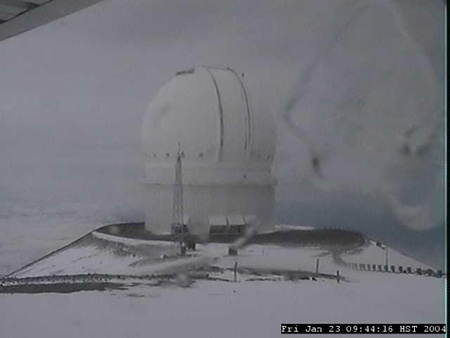


The Canada-France-Hawaii Telescope, as seen from the Gemini North observatory on Mauna Kea, Hawaii


My friend Peter Michaud just sent me this picture after I sent him an email whining about how cold it is here in New England. (It IS cold — subfreezing temperatures, wind chills, snow on the way.) Since he's in Hawaii, he countered with this little bit of "New England"-type weather out there in the sunny Pacific. Just goes to show you that even in Paradise, the weather can suck, even for stargazers!

posted by CCP on 1/23/2004 02:50:00 PM | * |

icon1.gif icon1.gif icon1.gif icon1.gif icon1.gif icon1.gif icon1.gif icon1.gif icon1.gif icon1.gif icon1.gif icon1.gif icon1.gif icon1.gif icon1.gif icon1.gif icon1.gif


1.22.2004


Extending Hubble's Lifetime


In the days since the announcement of the cancellation of the last servicing mission to Hubble Space Telescope, I've been reading a number of pages and discussions about what can be done to help HST along in its last few years. I think that Steve Beckwith, director of the Space Telescope Science Institute, has written a fairly concise summation of the announcement and his thoughts on the issue. You can read it here.

The American Astronomical Society has had some discussion in its members' email letters, and of course, the far-flung members of the observing community dependent on HST for their observations are quite concerned. Time and again the issue of using ground-based telescopes outfitted with adaptive optics is brought up, and while those are viable options, they do present limitations in terms of the field of view they can cover (along with other considerations). To put it bluntly, even if those are available all the time, when HST closes its lid for the last time and is de-orbited into the drink, optical astronomy will suffer limitations. Of course, historically it always has, but this past decade and a half since HST's launch have been good years for space-based optical astronomy observations.

And, I would be remiss if I didn't point out that adaptive optics-equipped facilities can and do outstrip some of HST's gains in some observations. HST may well have been one of the driving forces behind the steady improvements in AO technology, so in some sense, its legacy is felt on the ground as well. (Not that it has been the only driver... not by a long shot... but in the days after spherical aberration was discovered in the HST mirror, people began looking for ways to improve images made lousy by any kind of distortion!) Astronomy is blessed with a good number of outstanding ground-based observatories that can and will bear increased observing loads.

I don't want to lose sight of the fact that HST is good for a year or three more, and that its discoveries will keep researcher busy for decades, mining the data from its vast treasure trove of images and spectra. The disappointment at NASA's announcement last week is fading, although I am still very suspicious of the political timing of the announcement, coming as it did in tandem with the administration's unveiling "Bush Rogers" style missions to the Moon and Mars that I think have less than a snowball's chance in hell of surviving serious scientific scrutiny. (But since when has science ever trumped politics?) Scientists will always make do with what they have, and when they do, their results stem from the kind of ingenuity I admire in science (and which is all too lacking in the political sphere of tax-cut and spend practices).

So, the question in front of the community now is, "How do we get the most out of HST and also extend its life as much as possible?" The issues are complex — some of HST's most compelling observations do take a toll on its operations (particularly on the gyros, which help it slew around and hold position during observations). I think that with clever scheduling and maximization of resources, HST can be kept going for quite some time (or at least until its gyros fail, or some other component finally wears out). Of course, once its orbit decays (not an issue for a while yet), there will be little we can do to prevent it from re-entering the Earth's atmosphere on the final descent). But until that time, astronomers are looking for ways to get the most out of a very productive observatory. And, I'm sure that as they do, the ground-based observatories will see increased use. It will be an interesting next few years!

posted by CCP on 1/22/2004 11:09:00 AM | * |

icon1.gif icon1.gif icon1.gif icon1.gif icon1.gif icon1.gif icon1.gif icon1.gif icon1.gif icon1.gif icon1.gif icon1.gif icon1.gif icon1.gif icon1.gif icon1.gif icon1.gif


1.20.2004


Updates!


I've been gardening in my website lately, mostly doing little tweaks and updates. Since Mars is in the news these days, I've added three new images of the red planet to the gallery. I always think of the gallery as my small space museum, where I can put up pictures that I find particularly inspiring. The artist is the cosmos, and all I have to do is search out its handiwork to hang on the virtual walls!

Speaking of cool images, I ran across this one in my peregrinations.
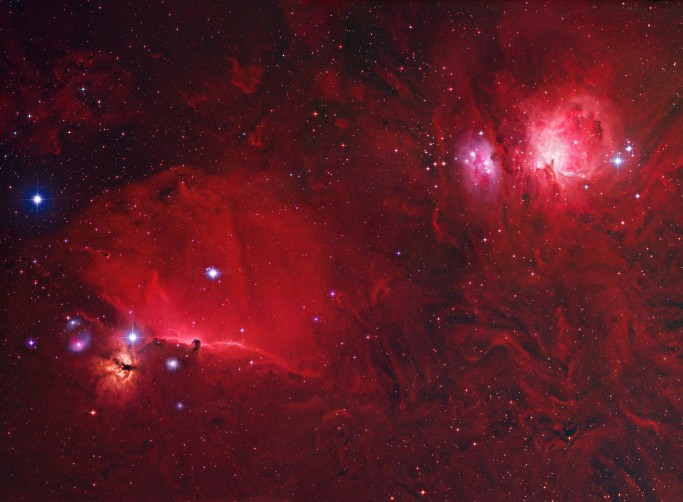


Credit: Bob Gendler, via the Astronomy Picture of the Day web pages.


It's one of those rare pictures that just transports you to space immediately, and I always wish I had a faster-than-light ship to take me out to such places as the Horsehead Nebula to see all the goings-on first-hand!

posted by CCP on 1/20/2004 12:24:00 PM | * |

icon1.gif icon1.gif icon1.gif icon1.gif icon1.gif icon1.gif icon1.gif icon1.gif icon1.gif icon1.gif icon1.gif icon1.gif icon1.gif icon1.gif icon1.gif icon1.gif icon1.gif


1.19.2004


Goodbye to Hubble?


Courtesy NASA Human Spaceflight Gallery


Hubble Space Telescope has been part of my life since 1988, when I first went to work at the Laboratory for Atmospheric and Space Physics, and found out that some of my tasks would involve the Goddard High Resolution Spectrograph on HST. I didn't know much about the scope at that time, since the mission had been delayed due to the 1986 Challenger disaster. Ultimately it got launched though, and despite tough times in the beginning, Hubble has been a hugely successful observatory. We've all known that it would serve us well for until at least 2008, but we never expected to see its mission cut short prematurely.

So, it's with a sense of frustration and disappointment that I found out about the plan to cancel HST's last servicing mission, due to safety reasons. I don't dispute those reasons, but I also smell an awful stink coming from the politically-driven announcement of missions to the Moon and Mars. I'm not against those missions, and if they were well-thought out, they'd be great. But they're not, and to trash a working observatory while at the same time announcing scientifically questionable lunar and Mars missions, is tantamount to junking a car because it needs a tuneup and announcing the purchase of a car that hasn't been designed yet. It's a lousy way to treat the international astronomy community, which has benefitted far more from access to Hubble's wide-field, high-resolution views than a few cowboy astronauts will do on a trip to the moon that won't happen for at least a decade (or more).

Fortunately, HST continues to work, and may last for a year or three more. I've just finished writing a planetarium show about HST, and there are so many good images from the telescope that it was tough to choose the slides to accompany the script. I hope that we'll get many more good ones before the scope whispers a last good bye before its fiery death in Earth's atmosphere.

posted by CCP on 1/19/2004 03:30:00 PM | * |

icon1.gif icon1.gif icon1.gif icon1.gif icon1.gif icon1.gif icon1.gif icon1.gif icon1.gif icon1.gif icon1.gif icon1.gif icon1.gif icon1.gif icon1.gif icon1.gif icon1.gif


1.16.2004


A Balmy Day On Mars is like
a REALLY Frigid Day in New England


So, Spirit is rolling around on Mars. It's another great time for Mars exploration enthusiasts, even ones as cold as I am here in New England. We were out riding around last night in our own planetary exploration vehicle, running errands and meeting friends for dinner, and for the Nth time, we realized that this little cold spell we're having right now (temps down below zero F (-17 C)) and freezing winds would constitute a balmy day on Mars! How so? Well, the average temperature on Mars hovers around -81 F (-62 C). The past few days, we've seen temperatures in New England go as low as -50F including the wind chill (or about -45 C). So, on Mars, this would be like an warm winter or early spring day maybe...

Of course, Mars doesn't have anywhere near the humidity we have on Earth, even on cold, winter days, or in our driest deserts. Mars is as dry as a bone, with most of the water probably socked underground as ice, or a mud-ice mixture called permafrost. And, the atmospheric pressure is quite a bit different on Mars. But as we in New England (and many other cold places on Earth) shiver during these cold times, we can sympathize with future Mars explorers who will have to contend with chilly temperatures all their lives as they learn what there is to know about another world.

posted by CCP on 1/16/2004 12:25:00 PM | * |

icon1.gif icon1.gif icon1.gif icon1.gif icon1.gif icon1.gif icon1.gif icon1.gif icon1.gif icon1.gif icon1.gif icon1.gif icon1.gif icon1.gif icon1.gif icon1.gif icon1.gif


1.13.2004


Life Extinction via Gamma Ray Burst?


Sometimes I'm asked if astronomy really does anybody any good — aside from astronomers, that is. I am always pleased to point out that most science does humanity some good, expecially if we pay attention to the results! Latest case in point is the never-ending saga of mass life extinctions on the early Earth. We all know about the death of the dinosaurs 'way back when, but there's clear evidence in the fossil record that life has been nearly wiped out several times since this old planet coalesced out of the primordial solar nebula. About 440 million years ago, in a geologic period called the late Ordovician, the second largest die-off of life occurred. About two-thirds of all species were wiped out. Hardest hit were the life forms that lived on or in shallow water. Deepwater organisms were hardly affected at all. The culprit? Astronomers think that increased ultraviolet radiation was somehow admitted through Earth's atmosphere in higher-than-usual amounts. This would serve to fry exposed life while not even bothering the buggies and critters hidden on the seafloor muck. What happened to the Earth's atmosphere? Usually it's pretty good about protecting the planet from UV — but, it's possible that a gamma-ray burst from a relatively nearby star that had exploded as a supernova and ultimately formed a black hole might be the culprit. Such a blast within 10,000 light years of the planet woul dbe enough to damage our atmosphere, introduce such pollutants as nitric acide rain, and seriously harm the ozone layer — the last line of planetary defense againsts lethal UV radiation.

We're just now starting to understand the mechanism of gamma ray bursts — in a few moments they send out so much light and radiation they can frequently outshine the galaxies where they live. So, it doesn't take much of a stretch to imagine what would happen to our planet if one happened nearby.

Did this happen? There's a lot of evidence in the fossil record. It would be neat to find a smoking gun supernova/black hole candidate — but in 600 million years, there are bound to be a lot of them that fit the bill. Singling out just one or two would be nearly impossible. But it's a neat theory and yet another data point to consider as we look for cosmic influences on our little watery globe.

posted by CCP on 1/13/2004 06:12:00 PM | * |

icon1.gif icon1.gif icon1.gif icon1.gif icon1.gif icon1.gif icon1.gif icon1.gif icon1.gif icon1.gif icon1.gif icon1.gif icon1.gif icon1.gif icon1.gif icon1.gif icon1.gif


1.11.2004


Winding Down


I got back from AAS early Friday morning and crashed for a couple of days. The Atlanta meeting was really quite a hoot. I had not attended a AAS meeting since summer of 2002 in Albuquerque, so it was a great chance to get caught up with all my friends in the community, as well as the latest Big Astronomy (or, as my friend Jim Kaler and I like to refer to it sometimes: Big-Ass Tro). I Fedexed a bunch of press releases and books back to myself, and will likely mine that info for the next few weeks as blogging material. But, it seems to me that there was an underlying theme in this year's results — maybe it wasn't intended, but it stood out to me: We're Finding Things Aren't Quite What We Expected. Not only is this true of stars and planets and galaxies, but also out at the "limits of the observable universe" where we should be seeing some of the youngest structures in the cosmos.

What does this mean? Did we misunderstand something? Is the timeline of the cosmos all wrong? Are things different out at 13 billion years ago? Is there a problem? As it turns out, not really.

We saw several press releases regarding deep-sky surveys looking at galaxies and objects as they appeared when the universe was maybe 2-3 billion years old. Astronomers expect to see (and in fact, DO see) galaxies in spiral shapes, galaxies in the process of assembly, and so on. But, in at least two surveys (that were discussed at press conferences), what they're also seeing are highly-evolved elliptical galaxies — ovoids are the likely result of two or more galaxies colliding and commingling. The gravitational forces and interactions reshape the galaxies and you ultimately get these elliptical things. It takes a while, and if it does take billions of years, then maybe the universe is older than we think, or maybe some of these collisions don't take as long as we think. Or there are some other factors that we need to account for in our calculations and theories about events in the young universe.

This is one of those interesting problems that our advanced telescopes and detectors are delivering frequently enough that we now sit here and scratch our heads for a little while before we plunge into the task of explaining why things look as they do. The theories are probably fine in general, but they likely need a little tweaking in the details. And that's cool because that's what science does best: it takes observations and use them to strengthen theories that explain the cosmos around us.

posted by CCP on 1/11/2004 03:37:00 PM | * |

icon1.gif icon1.gif icon1.gif icon1.gif icon1.gif icon1.gif icon1.gif icon1.gif icon1.gif icon1.gif icon1.gif icon1.gif icon1.gif icon1.gif icon1.gif icon1.gif icon1.gif


1.07.2004


More from the AAS


I've updated the list of cool press release stories from the AAS — if you want to read them yourself, point your browser here.

So, what's new at the meeting today? For the past couple of days I've been attending press conferences and browsing the exhibits hall. The exhibitors range from observatories and institutions to companies selling everything from software to hardware to planetarium instruments to jewelry, t-shirts and books. The press conferences have been extremely informative. We've learned about extrasolar planets, distant galaxy formation, a planet that has a strong magnetic field and is heating its own star (called the "Man (or Woman) Bites Dog Planet"), new mechanisms for star formation in colliding galaxies, and so many other things it's hard to describe it all. I think my favorite session was yesterday, when a group of us sat down for a writer's workshop about Mars, led by astronomer/artist William K. Hartmann. While I had some background in the subject, it was great fun to hear the latest and greatest from somebody who's active in the field.

posted by CCP on 1/07/2004 04:36:00 PM | * |

icon1.gif icon1.gif icon1.gif icon1.gif icon1.gif icon1.gif icon1.gif icon1.gif icon1.gif icon1.gif icon1.gif icon1.gif icon1.gif icon1.gif icon1.gif icon1.gif icon1.gif


I Love This Universe!


created by Mark C. Petersen


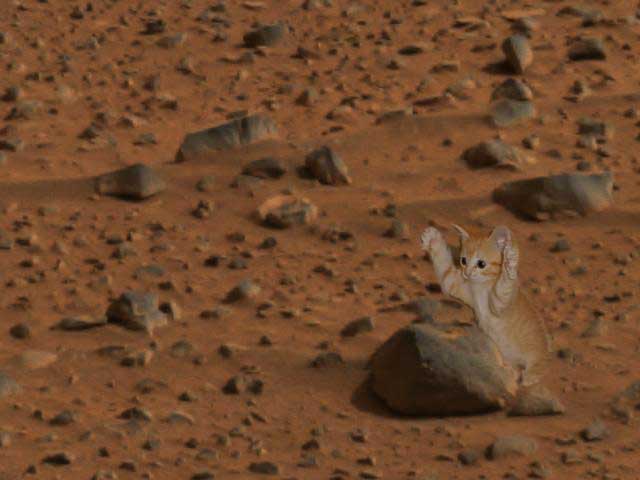
I'm still here at the American Astronomical Society and will be putting up a report tonight on the latest papers and stories being presented here — but I just had to share this one today. The infamous No Hands Cat has made it to Mars!

(If you want to learn more about this little guy, point to the No Hands Page.)

posted by CCP on 1/07/2004 08:42:00 AM | * |

icon1.gif icon1.gif icon1.gif icon1.gif icon1.gif icon1.gif icon1.gif icon1.gif icon1.gif icon1.gif icon1.gif icon1.gif icon1.gif icon1.gif icon1.gif icon1.gif icon1.gif


1.05.2004


News from
the American Astronomical Society Meeting:
Monday, January 5, 2003


It is always amazing to come to this meeting and take in the sheer number of astronomical papers and results that flow from the world's investment in cosmic research. Of course I can't take in all of the hundreds of papers and presentations — it's impossible. But, I do always give in to a sense of information overload by the end of the first day — and then I come back the next day ready for more, more, more.

So, what was hot in today's papers at AAS? Here are a few tidbits.

The first press conference a set of observations called the Gemini Deep Deep Survey (GDDS), a set of 50-hour-long observations that showed astronomers how the universe looked and behaved between 8 and 11 billion years ago. What they saw were fully formed, mature galaxies appearing at a time when astronomers expected to see little galaxies crashing together to form larger ones. The implications are still being discussed, but this means that a large number of the stars in the Universe were already in place and maturing when the universe was still only about a billion or so years old. There's a lot more at the Gemini web site.

Some years ago, a mysterious-seeming object called SS433 took the astronomy world by surprise. It appeared to be a strange thing with jets and a wobble in its orbital motion. Over time astronomers figured out a general explanation for SS433: a binary system with a neutron star or black hole being orbited by a "normal" star that periodically tosses some of its mass away. That material spirals over to the companion, winds up in an accretion disk surrounding it, and then is sprayed away through two powerful jets extending out from the companion. At today's press conference detailing the latest results, astronomers presented data from observations done using the Very Large Baseline Array and the Chandra X-Ray satellite to describe how the jets "precess" and cause the wobble seen in the object's orbital motion. While they haven't completely explained everything about this object, one thing is becoming more clear with each set of observations: the unseen object is a stellar black hole, and its jets are formed by the material it somehow can't "eat" completely. So, it tosses the stuff away. Images and a movie can be found here.

There's a star out there that may be the biggest and brightest in the Universe — according to Steve Eikenberry of the University of Florida. It's called LBV 1806-20, and it's at least 150 times the mass of the Sun and 5 million times brighter. You'd think we would have spotted something like this before, but it's been hidden behind a cloud of dust. A 17-member team of astronomers, using several telescopes to gather data, made a series of observations, using infrared studies and other techniques to measure the mass and brightness of the star. The big questions now are: is this really one star, or a cluster of them packed so tightly together that they can't be distinguished from each other? If it is one star, how did it get so big? While Eikenberry thinks it's one star, the other question can't be answered yet, but one thing is clear: stars that get that big don't last very long because they eat through their fuel at prodigious rates. Wanna see a pic of this stellar behemoth? Visit here.

Okay, that's it for this installment of "Fun at the AAS Meeting." I'll put up another report later on Wednesday.


NOTE: I've posted a list of press release stories from Monday and Tuesday sessions here.
All links were current as of noon Tuesday, January 6.

posted by CCP on 1/05/2004 05:00:00 PM | * |

icon1.gif icon1.gif icon1.gif icon1.gif icon1.gif icon1.gif icon1.gif icon1.gif icon1.gif icon1.gif icon1.gif icon1.gif icon1.gif icon1.gif icon1.gif icon1.gif icon1.gif


More Astronomy


Twice a year, many of the world's astronomers get together to "talk shop" about all the different disciplines in astronomy and astrophysics. This January's meeting is in Atlanta, Georgia, attended by about 2,000 scientists. I've been a member of AAS for about a decade and attend whenever I can. This time I'm here to cover the press sessions, meet with some publishers, and do a little background work on radio astronomy for some work I'm doing. Keep your eyes peeled on CNN.com or your paper for stories coming out of this meeting. And, as I get a chance, I'll post some cool info as I glean it!

posted by CCP on 1/05/2004 08:54:00 AM | * |

icon1.gif icon1.gif icon1.gif icon1.gif icon1.gif icon1.gif icon1.gif icon1.gif icon1.gif icon1.gif icon1.gif icon1.gif icon1.gif icon1.gif icon1.gif icon1.gif icon1.gif


1.02.2004


Solar System Exploration Continued...


British scientists continue to hope for communications with the Beagle 2 lander on Mars, despite pretty obvious signs that the mission has failed in some essential way. There are a number of reasons why they keep hoping, including considerations that it may have landed in an awkward position, or in a crater, or there's a problem with its transmitter, but they all add up to a disappointing return on investment for the research group. I hope they don't give up soon, but eventually they will have to face the reality that their lander didn't make it. You pick up the pieces and go on, no matter how difficult. In the meantime, the NASA Mars Express missions are about to commence -- the first one lands tomorrow (January 3) and if it makes it down safely, will deliver a mobile lab to the dusty red plains of Mars.

Today the Stardust mission has its close encounter with Comet Wild 2 and should pass within 200 miles of the comet's surface. If all goes well, it'll scoop up some comet dust and return a wealth of data about the conditions in the neighborhood. I think this is pretty cool, given that I studied comet plasma tails for a number of years. Granted it's a different breed of tail than the dust tail, but the mission is giving us another long-awaited "look" at a comet up-close-and-personal that astronomers have been anticipating for years. During the Halley years, we had a flotilla of six spacecraft head out to visit the comet's nucleus, and some pretty compelling images and data flowed out of that experience. I hope that the same result comes from this mission, and that the Mars folks get what they want, too.

posted by CCP on 1/02/2004 08:04:00 AM | * |

icon1.gif icon1.gif icon1.gif icon1.gif icon1.gif icon1.gif icon1.gif icon1.gif icon1.gif icon1.gif icon1.gif icon1.gif icon1.gif icon1.gif icon1.gif icon1.gif icon1.gif


icon1.gif icon1.gif

Earth Hour!

Do it for the Planet!

icon1.gif icon1.gif

Blog Roll

Planetarium-related

Loch Ness Productions
Purveyors of fine planetarium shows, music, and services.

INTENSELY Good Space Music
from a master in the genre!

My cool astronomy cause:
The Friends of the Griffith Observatory.
Join up today!

Science

The sites below belong to space and astronomy enthusiasts. I make every effort to check them and make sure they are still appropriate. However, I am not responsible for their content, nor do I endorse any of it by simply linking to them. As with all Web surfing, please exercise caution.


Adot's Notblog
A fellow traveler blogger and astronomy enthusiast!

Astronomy Blog
An astronomy blog pondering the big questions

Astronomy Cast
Astronomy Podcasting from Pamela Gay

BadAstronomy.com
Bad astronomy discussed and debunked along with fun stuff about really good astronomy!

Chris Lintott's Universe
Musings from an Oxford Astronomer.

Cosmic Variance
Random Samplings from a Universe of Ideas.

Dave P's Astronomy blog
Observational Astronomy and other TidBits

European Southern Observatory
Fine Ground-based astronomy images.

Gemini Observatory
Fine astronomy in infrared and visible wavelengths.

Griffith Observatory's page.
I wrote their exhibits!

Observing The Sky
Nightly Observation Reports from dedicated skygazers.

The Official String Theory Web Site. Time to feed your mind!

Pharyngula
Evolution, development, and random biological ejaculations from a godless liberal. Cast off your blinders and come on in!

Science Made Cool
A compendium of discoveries, inventions and commentary.

Slacker Astronomy
Astronomy with a Slacker Twist.

Space Telescope Science Institute
The best from Hubble Space Telescope

The Eternal Golden Braid
Astronomy, Space Science, and Science Fiction Commentary.

The Inoculated Mind
Bills Itself as a weekly science mindcast. Thought-provoking, honest.


Truth.

Unique

The Hairy Museum of Natural History
Defies description. Just go there (yes, it's safe for work).

Olduvai George
Absolutely fantastic natural history illustrations from a master.


News

The Agonist
News and Commentary

EurekAlert
Breaking Science News

National Public Radio
The Original Fair and Balanced

Slashdot.org
Like it says: News for Nerds


Shopping, Internet Stuff, and Web Guides

The Blog Search Engine Searching out the Blogoverse.

Blogwise.com
A blogger's listing service

Google
Best search engine

A blogger's listing service

Weblog Commenting and Trackback by HaloScan.com

The Truth Laid Bare Listings in the Blogosphere.


Links to My Site
Alternate Reality
An awful waste of space
Asa Dotzler - Firefox and more
A Song of November
Astroprof's Page
Astronomy Blog
Space/Astronomy
Bad Astronomy blog
BEEP! BEEP! IT'S ME
Bohemian Mama
boyruageek
Centauri Dreams
Colony Worlds
Cosmic Views
DaveP's astronomy
Dick's Rocket Dungeon
Electron Blue
Fly me to the Moon
From The Earth To The Moon
NYC Nova Hunter
Perspective and Soda
Robot guy
Salty Snack
Skymania's blogcast
Space Pragmatism
Solar Empire
Space Feeds
Space Law Probe
StarBaseOC
Sue Denham
Technology Integration
The Rabid Librarian's Ravings in the Wind
The Sublime Will
The Q80 Girl
TexasBestGrok
The Astronomy Blog
True Anomaly