I'm a science writer and editor. I work with clients in the observatory and planetarium community, as well as my own book, web, planetarium, and other projects.
Need a writer/editor? Visit my services page for my projects and availability.
Note: The ads you see below and at the bottom of this page are screened for content and many fine companies do appear here. Occasionally ads I don't want DO slip through, particularly for pseudo-science, st*r-naming, ID, and other questionable sites. Please understand that I cannot be held responsible for their content. Do visit them if you wish, but as with all advertising, be logical and use common sense.
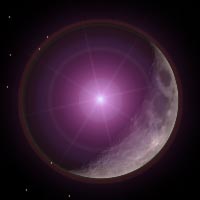
When our great-grandkids living on Mars go out stargazing, this is what they might see as they wait for the Sun to go down and the stars to start popping out. I've always wondered what it will be like for the first Mars residents to haul out a telescope and check out the stars and galaxies and planets. You know how we always tell everybody to dress warm here on Earth, even in the summer? Well, Martian stargazers won't have a choice. It'll be "dress warm, wear a pressure suit, and bring along plenty of oxygen." Or, maybe it'll be "remote" observing, with the telescope set up outside and the observer seated at the computer, safe and warm indoors. Not a whole lot different from what some observers here on Earth do!
The other day I was sitting here in front of my computer, flicking idly through the Mars pictures, and I saw a pretty neat one that I thought Mark would enjoy. So, I flicked on the intercom and said to him, "Hey, dear! Have you looked at Mars today?" And then it suddenly struck me just how wonderful and rare that was to say. I can log in to the MER site every day and look at the surface of a planet more than 55 million kilometers away. Most of the time it looks perfectly normal and familiar: rocks, dust, sky, Sun. Except there are a few differences: it's mostly red, there aren't any life forms, and there are those pesky little spheres that seem to be scattered all over Opportunity's landing site. Mysteries among the more familiar-type views of things we recognize.
So, go marvel at Mars. Check out the rocks. Mentally sift through the sand in those dunes. Imagine what it would be like to walk across those dried-up surfaces. And watch the sunset. We're living in a rare time!
It was about a 3-hour drive to the star party high in the Rocky Mountains. I was one of the invited speakers and was going up to give a talk about observing comets. The idea was that maybe there'd be a couple of talented amateur astronomers who might be interested in chasing comet tail for our team at the University. So, I packed up a trayful of slides, some warm clothes, and a couple of blankets and headed for the hills. The star party site was in a huge meadow reachable by 4-wheel drive, so of course I drove my Mitsubishi Eclipse up there. Got in okay, parked the car and headed for the main tent where they said there'd be a slide projector and screen set up.
I noticed about a dozen or so telescopes set up here and there, and little knots of people standing around each one, most of them watching another one do the scope setup. The sky was absolutely, utterly clear and it was going to be a nice summer night of stargazing. I introduced myself to the star party's host and he took me over to the slide projector so I could drop the tray onto it. Then we went over and got some dinner. It was the first star party I'd ever lectured at and only the second organized event I had ever attended.
After a burger and some beans and general chat with some of the other attendees, my host decided it was time for me to give my talk. He introduced me as one of the comet researchers from the University of Colorado and turned the mike over to me. I went on for about 30 minutes, showing everybody the kinds of images we were hoping to get from folks like them, and then spent a little while answering questions. By the time I wrapped, it was nice and dark outside and it was time for some stargazing.
The best parts about being a guest speaker at a star party (aside from the free food) is meeting a lot of really nice people and being able to wander around at will doing what I later learned is called "parasitic stargazing." That's when you don't have a scope of your own so you look through everybody else's. As a guest, I was welcome at everybody's eyepiece, and that night I saw a lot of cool stuff. By the time I crawled into the back of my car for a snooze around 3 a.m., I'd probably been up and down the summer Milky Way a few times at many different magnifications. It was great!
That star party, called the Rocky Mountain Star Stare, takes place every year. And so do many, many others, at dark sky sites scattered around the world. The year after I visited that one, I began working at Sky & Telescope, and over the next four years I visited star parties every year. I went from Boston to Vermont to Canada, over to Nebraska, out to New Mexico, and down to Pennsylvania a few times, and even took in a star party over in Europe. Each time was great fun, and each time I had the privilege of sharing some great tidbits about Big Astronomy or "Behind the Scenes at Sky & Tel" or other equally interesting topics with thousands of strangers who quickly became friends. And each time I was made welcome at the eyepieces of some really cool telescopes.
There are few better things people can do with their lives than stand out under an open sky with a group of strangers and simply admire the heavens. It's an amazing experience. And I'll never forget how much fun it was when I was doing it as part of my job. It was hard to believe I could have that much fun and get paid for doing it!
Our Eye On The Universe, courtesy NASA and the Apollo 17 astronaut crew. Bigger version
As you sit in front of the computer reading this, you're riding along on the largest telescope in the universe (that we know of). Oh, we're not all sitting on a huge reflecting dish or anything like that. But, we do share surface of the planet with hundreds of observatories. The result is that there isn't a moment of the day when all parts of the sky in every direction aren't being studied by a telescope somewhere, somehow. That's pretty amazing until you stop to think about how many telescopes there are in the world — including all the amateur gear! And, if you rise up a few hundred km into space, we have another whole collection of space-based "eyes on the sky."
The Big Island of Hawaii is home to a great collection of observatories, among them the Gemini installation, the Keck Observatory, the James Clerk Maxwell Telescope, the University of Hawaii 2.3-meter telescope, and many others. The National Observatory of Japan has an installation up there with the others on Mauna Kea: the Subaru telescope. I used a couple of their lovely images in my book. Here's their latest.
It's the Sextans A galaxy, a dwarf Irregular galaxy — a close neighbor to the Milky Way at only 5 million light years away. Here's what the Subaru folks have to say about their image:
"Young blue stars and older yellow and red stars shine against a dark sky like jewels in a treasure chest in this image of Sextans A from Subaru Telescope?s prime focus camera Suprime-Cam. Sextans A is a dwarf irregular galaxy belonging to a group of galaxies called the Antlia-Sextans group 5 million light years from Earth. Even though five million light years is quite distant (50 billion billion kilometers or 30 billion billion miles), only about 40 galaxies are closer to our own Milky Way galaxy than Sextans A. The Antlia-Sextans group is the closest neighbor of the Local Group, which includes both our own Milky Way the Andromeda Galaxy.
Irregular galaxies do not have a regular symmetric shape like spiral or elliptical galaxies. Dwarf irregular galaxies containing only 100 million to a billion stars are the most common type of irregular galaxy. One main characteristic of dwarf irregular galaxies, other than their shape, is vigorous ongoing star formation. Sextans A has a mass comparable to only 100 million stars, one thousandth of the Milky Way, but contains a comparatively large amount of gas and dust, the raw ingredients for stars and planets. In the center of Sextans A is a high concentration of neutral hydrogen gas that serves as a reservoir for the formation of new stars. The Suprime-Cam image shows both young stars (blue) old stars (red) near the center of Sextans A where there is a large reservoir of neutral hydrogen gas and star formation is most vigorous. The green color highlights hydrogen gas ionized by radiation (HII regions) from the blue-hot young stars.
Many dwarf irregular galaxies are surrounded by neutral hydrogen gas that extends far beyond where the galaxy?s starlight fades away. Observations with radio telescopes have confirmed that Sextans A is no exception. The origin of this hydrogen gas and its effect on star formation are still unsolved puzzles. Yutaka Komiyama from Subaru Telescope, the observer of Sextans A, is now working on a solution using the Suprime-Cam data."
Sometimes people think that you have to set aside hours and hours to do stargazing. It ain't so! Some evenings you can take a big bite in a short time, what I like to think of as "Big Gulp" stargazing. Last night when I went to put the trash out, I stood there and took in the crescent Moon and Venus low in the western sky. Over in the southwest, Orion was doing his thing, and high overhead Saturn glittered in Gemini. Jupiter was hanging there in the East. Lots of stuff to take in on just one quick trip out with the trash cans! Now, if you want to try it, take along a pair of binoculars and check out the planets or the Orion Nebula. Tonight (Tuesday, Feb. 24), the crescent Moon, Mars, and Venus will all be lined up low in the west after sunset. Wednesday night, the Moon and Mars will be very close together. It's a free star show, and all you have to do is step outside after sunset and look up! (And hope it isn't cloudy.)
Yesterday there was a news conference at NASA about something called "dark energy." What is this stuff? Well, strictly speaking it's not matter. It's a force. We're all familiar with the force of gravity, which acts to hold things together, particularly at the atomic level. Across huge distances — and I'm talking big ones, like between galaxies and clusters of galaxies (what astronomers like to refer to as "cosmic" distances"), gravity is part of a complex dance that warps galaxies that pass too close and keeps members of a cluster more or less together. Important stuff, this gravity. We all know that the universe has been expanding since the Big Bang, about 13.7 billion years ago. Everybody just assumed that gravity would have some effect on this cosmic expansion, maybe even slow it down.
Such a gravitational braking force would affect light from distant objects, and people who study shifts in the wavelengths of light from very distant stellar explosions called Type Ia supernovae though that they'd see the slowing effect of gravity in the spectra (the minute details of the light) of the supernovae. Turns out they didn't. In fact, what they DID find is that the expansion of the universe is speeding up! Something is accelerating the expansion and this speed-up started about 5 billion years ago — roughly about the time our Sun and planets were forming.
That "push apart" force is called "dark energy." It's a lousy name for a factor that Albert Einstein postulated way back in the early years of the 20th century. He couldn't believe it existed and so he discarded it. In retrospect that doesn't look like a good move on Einstein's part, but hey — you have to admit it does seem a little strange to have something mysterious out there pushing the galaxies apart faster than gravity can hold them together.
Now, this dark energy doesn't act on something as small as our planet or you and me — like gravity at cosmic scales, it acts across cosmic distances. So, I wouldn't worry too much about the solar system flying apart or the Milky Way doing something brash like sending the Orion Arm on over to Andromeda for a friendly visit. It doesn't work that way. The full extent of dark energy's influence will echo across time for another 30 billion years or so, if it continues pushing at its presence pace.
It's not really a big thing to worry about personally, but as part of the puzzle that is our universe — and while we understand much about the cosmos, we certainly don't have a handle on all of it — it certainly does pose a tantalizing new piece for scientists to chew over as they push the limits of our telescopes back to the earliest epochs of history. Keep your ears open for more on this dark energy stuff — and don't believe anybody who tells you it's a fantastic new source of energy for perpetual-motion machine. That's woo-woo territory...
A short programming note: I'd like to direct your attention to the link I added for Gemini Observatory over in my links column on the left. I've been doing some work with the fine folks there and I thought you might like to see some of the good astronomy they've been doing with their telescopes at Mauna Kea and Cerro Pachón in Chile. Give 'em a visit and see what's new at Gemini!
Courtesy Mars Exploration Rover Gallery pages. The area in this image is approximately 3 centimeters (1.2 inches) across.
My grandfather used to have a saying whenever he'd hear something amazing (good news or bad). He'd shake his head and say, "By golly, that's really the berries." I thought about that when I saw the first pictures of Martian "berries" come down from the Opportunity Rover. He'd probably have said that if he'd lived long enough to see what we've been seeing on Mars this past few weeks.
It has been amazing. I don't think anybody could have predicted these little berry-shaped things scattered all over the place. To me they look like hardened dustballs or maybe little crystals that have bounced along the surface, maybe pushed along by the winds. I've seen others speculate that they're tektites — pieces of glass formed when a large meteorite strikes the Earth. (You can read more about tektites here.) I'm looking forward to hearing about the geologic analysis of these things once the mission scientists have had a chance to examine more images of them.
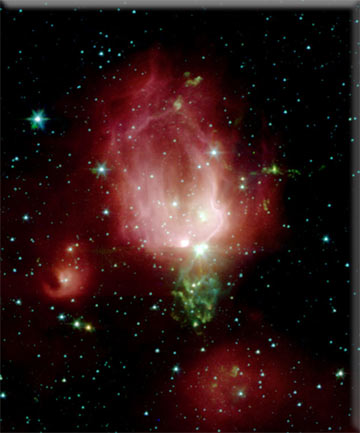
This Spitzer Space Telescope image was obtained with an infrared array camera sensitive to invisible infrared light at wavelengths that are about ten times longer than visible light. In this four-color composite, emission at 3.6 microns is depicted in blue, 4.5 microns in green, 5.8 microns in orange, and 8.0 microns in red. The image covers a region that is about one quarter the size of the full moon. Courtesy of Spitzer Space Telescope
This is kind of cool. The folks at Spitzer Space Telescope have caught onto the "positive PR spin" thing pretty well and have issued a lovely picture of a rosebud-shaped stellar nursery called NGC 7129. Smack in the middle of the bud is a cluster of newborn stars, and all of this loveliness lies about 3,300 light-years away in the constellation Cepheus. There are about 130 young stars here, all formed from a huge cloud of gas and dust.
Here's what the Spitzer folks have to say about their discovery:
"As in any nursery, mayhem reigns. Within the astronomically brief period of a million years, the stars have managed to blow a large, irregular bubble in the molecular cloud that once enveloped them like a cocoon. The rosy pink hue is produced by glowing dust grains on the surface of the bubble being heated by the intense light from the embedded young stars. Upon absorbing ultraviolet and visible-light photons produced by the stars, the surrounding dust grains are heated and re-emit the energy at the longer infrared wavelengths observed by Spitzer. The reddish colors trace the distribution of molecular material thought to be rich in hydrocarbons.
The cold molecular cloud outside the bubble is mostly invisible in these images. However, three very young stars near the center of the image are sending jets of supersonic gas into the cloud. The impact of these jets heats molecules of carbon monoxide in the cloud, producing the intricate green nebulosity that forms the stem of the rosebud.
Not all stars are formed in clusters. Away from the main nebula and its young cluster are two smaller nebulae, to the left and bottom of the central "rosebud," each containing a stellar nursery with only a few young stars.
Astronomers believe that our own Sun may have formed billions of years ago in a cluster similar to NGC 7129. Once the radiation from new cluster stars destroys the surrounding placental material, the stars begin to slowly drift apart. "
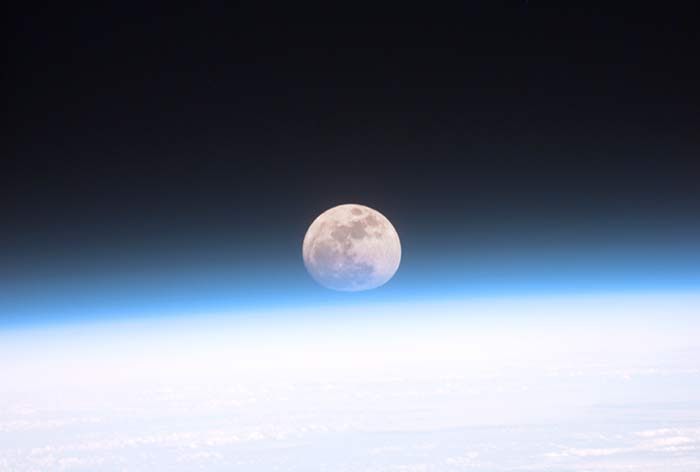
During the December 1999 servicing mission of the Hubble Space Telescope, astronauts aboard the Space Shuttle Discovery recorded a magnificent image of the full Moon partially obscured by the atmosphere of Earth. It's rare to see the Moon this way, even from space (so they tell me), so when I ran across this during a recent archive search, I downloaded the image immediately for my collection. I love going through the image archives because they are such a valuable record of the achievements people have made in space. I fear that the way things are going, what with the cancellation of the next servicing mission to HST, plus the emphasis on Moon and Mars missions that seem to be driven more by political ambition than good science returns, the scenes recorded in NASA's vast image collections may not be repeated for a long time.
Mind you, I have no problems with missions to the Moon and Mars, or even to the stars. We should have been doing them all along and by now we should have places to visit and study on the Moon. But, history and politics and Earth-based problems have taken their toll on the space program in many ways. That's the reality of big "public works" projects, no matter what they are and which country is funding them. They are a mix of hopes and dreams and scientific goals and political realities and cultural mindsets and human fears and emotions. Sometimes I think it's a wonder huge projects get done at all, except that I know how teamwork can advance even the most difficult objectives.
And so it is with space exploration. We will get out there. The big questions remain to be answered. When? How? Who will go? Who will pay? Who will benefit? How can humans team up to make the scientific, cultural, political, and financial advancements necessary to accomplish the goals? Big questions, all of them. They loom over our future in space like a huge nearly full Moon, bright and shiny and beckoning. It's a challenge in a way, and it's one from which I hope we do not back down.
Okay, raise your hands — who went out and checked out the Moon, Jupiter, and Saturn the other night? Great. I hope you didn't freeze your buns off! (If you live where it's cold... ) I went out for a little while and looked at the Moon, but we had partly cloudy conditions, so there wasn't much else to see. Probably the same for tonight, but I'll give it the ol' college try.
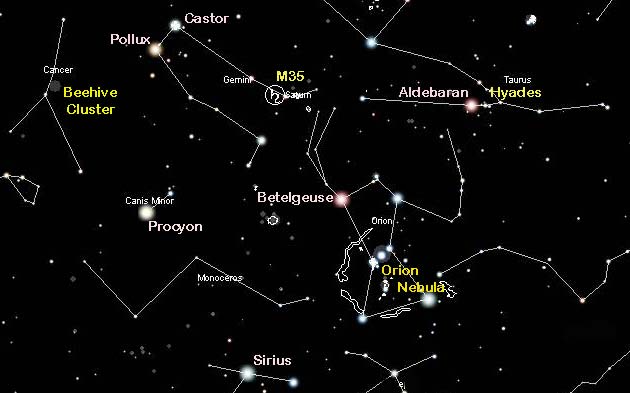
When they're clear, these February nights give us a nice chance to do some prime-time viewing of some "good stuff." Anybody who's been reading these pages for a while knows that I like the Orion sector of the sky, probably because I find the Orion Nebula so fascinating. The whole area is a veritable trove of things to look at — including some fine little clusters that you can see with binoculars.
Over in Gemini, down by Castor's ankle (and not far from Saturn) is the open cluster M35. And there's another cluster over at the heart of Cancer, called The Beehive. I remember when we were onboard the MS Ryndam a few years ago seeing the Beehive low in the northern sky (we were in South America). It was a different viewpoint than I was used to because I usually see it higher in the sky from our more northern viewpoint in New England. And, for good measure, Orion was tipping over with his head toward the horizon.
Look over at the Hyades in Taurus and you'll see another open cluster, with the reddish-orange star Aldebaran in the view. And of course, there are the stars at the heart of the Orion Nebula (bringing us back to Orion). The Trapezium comprises the brightest four of hundreds of newborn stars in this starbirth region. It always amazes me to think of a starbirth nursery only 1,500 light-years away from Earth!
These are the best of my winter night favorites, at least until the next time I go out and find something else to look at! That's the great thing about skywatching — there's always something new to find along with the old friends!
It's February and colder than heck here these days. That's about what you'd expect for Northern Hemisphere winter (particularly in New England). But, that doesn't stop me from stepping out at night and at least giving the night sky a quick look.
Here's a quiz: what's up tonight? The Moon? Any planets? What constellations are up at 10 p.m.? If you have 10 minutes to stand around outside, you can have a quickie star party for yourself and any loved ones you can dragoon into going out with you.
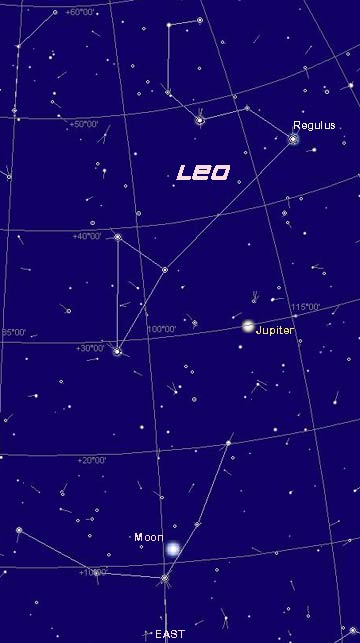
As it turns out, we're just a couple of days past Full Moon, so if you look low in the East around 10 p.m., you should see a nearly-full (early waning gibbous) Moon somewhere around 10 degrees above the horizon, just below Leo and in Virgo. If you have a pair of binoculars and a clear sky, check out the lunar surface!
What's Leo? It's the constellation depicting a lion, but you won't find a giant feline. What you really want to look for a giant, backwards question mark. The bottom of the mark is the bright star Regulus, which you can think of as the heart of the lion.
Now, as it turns out, there's something ELSE bright in Leo. That's the planet Jupiter. It looks like a bright star, but if you watch for a while, and compare it to the stars, you'll notice that it doesn't appear nearly as "point-like" as stars do. (Although, if you have a lot of turbulence in your air tonight, everything will look like it's shifting and twinkling, so you do have to observe Jupiter several times to get a feel for its disk-like appearance compared to stars (which do look pointlike and twinkle).
Also, Saturn is still putting in a nice appearance over in Gemini, which at 10 p.m. or thereabouts, will be almost overhead. I posted a map here, for New Year's Eve that shows Gemini and Saturn almost overhead at midnight. Now, a little over a month later, they're almost overhead around 10 p.m. so you can use that map to get a feel for the whole sky. If you have even a small telescope, you should be able to see the rings quite nicely.
For what it's worth, although the Moon will move out of the view fairly quickly over the next few nights, Leo and Jupiter will look pretty much the same for quite a while. Try going out a little later at night to see them higher in the sky. If you're really hardy, check 'em out after midnight — say around 2 a.m. They'll be really high in the sky.
Here's a map to help you find Jupiter, the Moon, and Leo tonight.
Map done in Cartes du Ciel
Freezing yet? Okay. Head back in, get a cup of hot chocolate or tea! You've earned it! That's what I do. Stargazing for me isn't always a matter of standing outside for hours, looking for dim, distant objects. Sure I do that too. But sometimes it's as quick as stepping out for a quick look and a little bit of starhopping!
I keep heading back to Mars, along with a lot of other folks who are interested enough in the Mars Exploration Rover mission to log in and see the "latest from Mars." It's sort of like having a web cam on Mars, and for Mars junkies, that's great!
So, I was looking at this shot from the gallery today, taken on Sol 13, and it struck me again how familiar this alien world looks. These could be rocks I've hiked over on dozens of geology field trips back in college, or family jaunts to the mountains and desert. Once in Hawaii, I was hiking on a cinder cone and if I hadn't been surrounded by scenery that told me otherwise (and of course, a breathable atmosphere), I could have been strolling across a cinder cone on Mars. The colors and textures were similar to scenes we've seen in Mars images.
Make no mistake, Mars is NOT Earthlike in any survivable sense. It may look just like the Arizona desert or a lava cone on Mauna Kea, but take one step onto the Martian surface without a survival suit and you'll find out the difference! Still, that "hominess" that we all read into Mars may be the key to getting us off our duffs and actually sending people to explore it. That's my hope, anyway.
I do my bit to encourage Mars interest — like posting pictures that catch my interest. In my planetarium show, "MarsQuest" I thought long and hard about simple ways to bring a sense of familiarity with Mars to audience members. Sure, the pictures will do it, and finding a way to say that in some ways the planet is just like Earth (while in other ways it isn't), are good methods. But, here's another one: place names.
Ever get ready for a trip to someplace you'd never been before? You look over a map or read a book about it or talk to people who have been there and can give useful tips. You learn how to pronounce "Las Ramblas" if you're going to Barcelona, read the guidebooks about the parks and churches and restaurants and maybe pick up a few phrases of travel Spanish to help you order food, get a good hotel room, and catch a taxi. What if you're going to Mars? Why, you learn the place names! And Mars has plenty of good ones, like Meridiani Planum and Gusev Crater. So, in MarsQuest, I have our narrator rolling some wonderful Martian place names across his tongue: Cydonia Mensae, Valles Marineris, Ares Vallis, Noctis Labyrinthus, and Olympus Mons.
Get used to those place names folks. Learn how to say them, and as you do, think about the landscapes they portray and the experience of being the first (or second, or tenth or twentieth) person to stroll the dusty plains of Mars or crawl up the gentle slopes of its towering volcano. It's not quite as good as being there, but until we get a viable Mars mission plan in place, we'll make do with vicarious explorations via the Mars landers and orbiters we've already sent.
NOTE: A special thanks to Stu Goldman at Sky & Telescope for writing up this blog in his Astronomy Online" column in the March issue of S&T. And a warm welcome to S&T readers! It's been a few years since I left the staff of S&T to pursue other things, but I still see my friends on the staff once a month or so, and of course I still think about all the readers I met when I represented the company at star parties and astronomy meetings.
I was talking to a new friend at a meeting a few weeks back and we were swapping tales of life experiences. Many I've had in my life revolve around my interest in astronomy. I guess for a 50-year-old you could say that I've done a few things, but this person was just getting to know me and the more we talked, the more I kept hearing, "Man, you've been there and done that!"
It reminded me of the time Mark went to record actor Avery Brooks in a narration session for one of our shows and he asked Mr. Brooks if he'd ever been to a planetarium. Brooks patiently said, "I'm 50 years old... " At the time, I thought that sounded kind of cheeky but now that I'm at the same place he was, I kind of know the feeling he was communicating.
A long time ago I worked at the Denver Post. Due to a lack of a journalism degree (although I had another degree and a few semester hours in newswriting and newsphotography), they stuck me in as an editorial assistant. Eventually I got to do some reporting, but it took a while. It finally dawned on me that I could ASK to cover science stories. So, after I asked enough times, they finally let me go out to JPL to cover the Voyager 2 encounter of Saturn. That was a valuable lesson, and provided me with a couple of mantras that have stood me in good stead: "You don't get if you don't ask" and "Don't let anything stop you."
Over the years I've tried to stick to those precepts, not always with complete success, but they have opened up some avenues of experience for me.
Like the time I was hired to be the "trip astronomer" by an mountaineering adventure travel company that wanted to make gobs of money sending folks to South America to see Comet Halley. I spent 3 weeks in Peru, guiding two successive groups of tourists to dark sky spots to see the comet. It was in the heydey of the Sendero Luminoso and they had a penchant for blowing up power stations — which they proceeded to do just as our plane from Miami was touching down at the Lima Airport. I'll never forget getting off the plane, walking across a pitch-dark tarmac and looking up to see the Southern Milky Way for the first time. It was magnificent!
Little did I know that a few years later, I'd be researching plasma tail orientations on thousands of pictures of Comet Halley as part of a research team!
Most people who know me know that I have a "thing" for Mars. It stems 'way back to childhood and it has taken me to Case for Mars meetings, planetary science courses and meetings, and out to cover Mars missions at JPL. Well, during grad school I signed up for a planetary science seminar and one of our field trips (geology is fun that way — the field trips are a gas!) was to study volcanism on Mars. Only instead of going to Mars, we went to the Big Island of Hawaii. Twice. Both times we sampled lava as it was flowing down to the sea, tramped across newly-laid lava beds, studied sapping valleys, and got to know parts of the Big Island better than we knew the CU campus. It turned me into a lava junkie, and there is just no way to describe the incredible rush of fear, interest, excitement, and adrenalin that comes from chasing the wild pahoehoe. Tempered, of course, with scientific inquiry.
Also during grad school a bunch of us who shared an office decided we all wanted to learn to downhill ski. So, for two winters we regularly drove up to Eldora or Breckenridge or Loveland or Winter Park, took our lessons, and had a blast. I never got to be too good at it, although I could hold my own on the blue slopes. But, one time I found myself on a black diamond slope. It looked like I was diving over a cliff. My choices were to ski down or walk down and there was no way I was going to walk. So, I put myself into the most severe snowplow I could muster and I bitched my way down that mountain. It went like this: snowplow ten yards, hit a rock, stop. Yell at myself to "keep going, woman! you can do it!" (only I didn't say "woman"). Go another ten yards, slip and fall, get up, yell at myself some more. Stop to catch my breath. Go another ten yards, and another, and another, all the way down keeping my spirits up by giving myself hell. It was a terrific confidence builder, that run was. When I got down to the entrance to a blue slope it was as if I'd found the Promised Land. Some of my buds were waiting for me there and they had watched me make my way down. The guys just joshed me, we went off to lunch, and that afternoon we did it again! And the second time was just as scary as the first, but at least I'd done it!
Stuff like that makes life worth living. But so do most of the things that are hard-won and precious. And in the next 50 years, I hope I have more experiences like them! I often think that if it wasn't for my love of the stars, my fascination with Mars, and my desires to share all that with other people, I wouldn't have done any of it. And then where would I be?
Courtesy Space Telescope Science Institute and European Space Agency
We usually think of space as this serene place where stars shine and planets bob around and galaxies are out there. Except, of course, it's not quite true. Depends on where you're looking to and from. Take the the nearby dwarf galaxy NGC 1569 as an example. It's a close (meaning it's about 7 million light-years away) starburst galaxy — a hotbed of vigorous star birth that blows huge bubbles of gas. The galaxy's "star factories" are also manufacturing brilliant blue star clusters.
As it turns out, NGC 1569 had a sudden onset of star birth about 25 million years ago. Lots of new stars were born and then things quieted down a bit about the time the very earliest human ancestors appeared on Earth.
This new image from the Hubble Space Telescope shows the bubble structures being sculpted by galactic super-winds and outflows. These are the result of supernova explosions that are themselves linked to massive episode of star birth. That makes sense when you think about it: the stars are born, and then some millions of years later they start to die. If they're massive stars, they live short lives (well, short compared to longer-lived stars like the Sun) and die spectacularly as supernovae.
This whole episode of star formation and star death, intertwined in a single spectacular image, brings us to one of the still unresolved mysteries in astronomy: how and when galaxies formed and how they evolved. Most of today's galaxies (including the Milky Way) seem to have formed quickly very early on in the history of the universe. Galactic births very likely involved one or more galaxy collisions and/or episodes of strongly enhanced star formation activity (the so-called starbursts).
While any galaxies that are actually forming are too far away for detailed studies of their stellar populations even with Hubble, their local counterparts, nearby starburst and colliding galaxies, are far easier targets. NGC 1569 is a particularly suitable example, being one of the closest starburst galaxies. It harbors two very prominent young, massive clusters plus a large number of smaller star clusters. The two young massive clusters match the globular star clusters we find in our own Milky Way galaxy, while the smaller ones are comparable with the less massive open clusters around us.
The majority of clusters in NGC 1569 seem to have been produced in an energetic starburst that started around 25 million years ago and lasted for about 20 million years. The bubble-like structures that resulted are made of hydrogen gas. It glows when hit by the fierce winds and radiation from hot young stars and is racked by supernovae shocks. The first supernovae blew up when the most massive stars reached the end of their lifetimes roughly 20-25 million years ago. The environment in NGC 1569 is still turbulent and the supernovae may not only deliver the gaseous raw material needed for the formation of further stars and star clusters, but also actually trigger their birth in the tortured swirls of gas.
So, in one image you get starbirth, stardeath, galaxy evolution, and something a little more: another great image to learn from, thanks to the Hubble Space Telescope.
The sites below belong to space and astronomy enthusiasts. I make every effort to check them and make sure they are still appropriate. However, I am not responsible for their content, nor do I endorse any of it by simply linking to them. As with all Web surfing, please exercise caution.
Adot's Notblog A fellow traveler blogger and astronomy enthusiast!
Astronomy Blog An astronomy blog pondering the big questions