 |
 The SpaceWriter's Ramblings |
|
||


|
|
|
||
|
Anything and everything about science, especially astronomy and the cosmos.
Visit my web site at Posting times are Powered by
|
6.30.2004 Cassini Arrives at Saturn
A couple of weeks ago I wrote about my first experience covering a planetary mission at the Jet Propulsion Laboratory in 1981. It was Saturn, and in a great deja vu experience, 23 years later, I'm watching from the comfort of my home office while another mission prepares to explore Saturn in greater depth. It's not nearly as heart-pounding (for me, anyway), but for the mission planners who have been waiting for 7 years for this moment, it is astoundingly exciting, the chance of a lifetime to study Saturn. The Saturn image here was taken a couple of days ago and it brings all those memories back... and entices us to imagine what the next months of exploration will bring us. Stay tuned!
6.29.2004 Thinking about the UniverseWhen I was a teenager there was a popular poster with a poem called "Desiderata." One stanza of this work particularly caught my attention:
That poster hung on my wall for a couple of years until I headed off to college, but I credit it with reawakening my interest in all things cosmological. (Though I doubt I thought of an interest in the origin and evolution of everything in the universe as an interest in cosmology.) I think that reading that piece was the first time I heard a glimmering of the idea that right down to our blood and bones and the air we breathe and the light we see we are intimately tied to the stars and galaxies.
Radical idea that, especially if one believes in alternate theories of creation. It seems only natural that an evolving universe would eventually come up with stuff like human beings, although we now know that life (at least as we know it) is the result of many rare confluences of events and processes. Some say that argues for a creator, or some organizing influence. Others say that it doesn't. In truth we'll never really know because so much of the universe, particularly the instant of its birth (the Big Bang) is forever veiled from us. But we use astronomy and astrophysics to probe as much as we can into the depths of the cosmos to find clues to the origins of everything we know.
It's my opinion that the universe has no conscious, overarching planner shoving the cosmic chess pieces here and there just to see how things will turn out. Sure there are laws which govern the actions of matter (all forms) and forces, but those aren't evidence of such a planner. Is there an organizing principle? Sure. But again, that's no evidence of a planner.
In truth, it's not important (in the cosmic scheme of things) that a set of life forms on a planet hidden away in the outskirts of a galaxy (one of billions of galaxies) has devised some cosmic architect and insists that everyone was created by that unseen influence. What IS important that we continually search the cosmos for answers to how everything we can detect came about, how the stars and galaxies were formed, and what processes lead the constant unfolding of the universe. In the end, that's all we can really do—strive to learn. posted by CCP on 6/29/2004 07:10:00 PM | *
6.24.2004 Have You Seen the Stars Tonight?Back when I was in college and we used to hang around the planetarium, the laser light show started with a song from the Jefferson Starship album, "Blows Against the Empire" called "Have You Seen the Stars Tonight?" It was a song from a man to a woman, both aboard a starship in the future, and he's inviting her up to A Deck to see the stars. I always thought that was a romantic thing, embodying so much about stars and space exploration. Here's how it goes:
Maybe we'll never get to the stars, but humans have a powerful link to the stars built into their bodies and thoughts. All we have to do is look up, and we're looking at our past, and maybe our future.
So, have YOU seen the stars tonight?
6.22.2004 Hubble in the Domed EnvironmentWe've just spent the past few months creating a show about Hubble Space Telescope science. It was produced mainly for planetariums, but I'd love to see it get out into classrooms, if we could just figure out a way to market it. Astronomy's such a cool subject and people always want to know more about it. Of course, the beauty of astronomy, in addition to the great pictures and wonderful science results flowing from every observatory on (and above) the planet, is that there's always something new coming up.
In the case of Hubble Space Telescope, the discoveries keep marching down the pipeline and putting together a planetarium show (or any kind of presentation about HST) is kind of like holding a bucket under a firehose and gathering in as much as you can until the bucket overflows. I had a wealth of images to choose from, but still, it was a tough job just figuring out what NOT to use! Ultimately I ended up selecting a couple of hundred images in the first cut, winnowing that down to just under 200, and then adding in some graphics and other visual material. Then it was time to produce! The story just wrote itself. Seldom does it just flow out as it did with this one. I guess that's a sign of goodness; I know from experience that sometimes writing isn't so easy and the words don't always come tripping out of the word processor like they did for this one.
6.18.2004 For Your Gazing Pleasure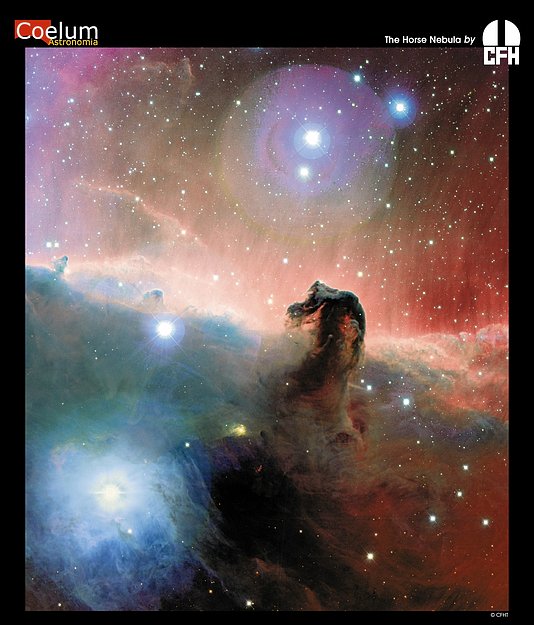
The Horsehead Nebula, courtesy of Jean-Charles Cuillandre and the Canada-France-Hawaii Telescope.Evocative. That's one word I can use to describe this amazing image of the Horsehead Nebula. Stunning is another. I think that's what Dr. Jean-Charles Cuillandre, who works with the Canada-France-Hawaii telescope atop Mauna Kea, had in mind when he started a "pretty pictures" program of imagery.
Prosaically speaking, this is a cloud of gas and dust being lit up by a hot young star. It's just a coincidence that the darkest part of the image, the Horse's head, looks like a horse. What's cooler to contemplate is what's inside that horsey-looking cloud. Maybe a newborn star waiting to eat away the remaining cloud and burst forth with light in a few hundred thousand years? It's possible.
Starbirth is like that — full of surprises. And areas of starbirth are among the hottest (literally) topics of astronomy research today. Lucky for us, scientists like Dr. Cuillandre are ready, willing, and able to give us "front row" seats for the festivities! posted by CCP on 6/18/2004 11:35:00 AM | *
6.13.2004 How Time Flies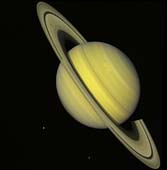
Saturn as seen by Voyager 2 in 1981, courtesy Solarviews
Saturn as seen by Cassini, courtesy Cassini Mission.Twenty-three years ago this August, I covered my first planetary mission—the Voyager 2 flyby of Saturn—as a science correspondent for a newspaper. In a moment of sheer bravery, I approached the unknown of the outer solar system and found myself immersed in the fascinating scientific exploration of gas giant worlds. It's fair to say that it changed my life in ways that are still to be measured. Today, a month or so short of the NEXT spacecraft to visit Saturn, there are so many things that are different about me, and I know there will be many new and different things scientists will find out about Saturn.
I don't recall all the details of that first, frenzied week of science coverage back in 1981. Some images stand out in my mind: the first picture of the moon Enceladus, for example, and the worried looks on scientists' faces when the camera scan platform jammed. I remember driving up to Jet Propulsion Laboratory for the first time and just sitting there in the car, drinking in the sights and sounds of a place that, for me, still held all the excitement of the lunar missions and the Mars explorations of the Viking era. I remember feeling slightly in awe of the scientists who carefully explained the images we were seeing, and even MORE in awe of the science writers around me, who seemed to be part of an exclusive club.
They welcomed me into that club, and I am proud to know and call "colleague" many of today's best science writers. But back then, I was the equivalent of a college freshman, going to her first classes and hoping that she wouldn't do the wrong thing or ask a stupid question. I grew up as a science writer during those planetary missions, learning from the best; ultimately I covered Voyager encounters of Saturn, Uranus, and Neptune, and a couple of Mars missions: Pathfinder and the ill-fated Polar Lander. Each time I'd head out to JPL like a moth to a flame and spend days and weeks learning more about planetary science each time. To be sure, in between times, I went back to school, studied planetary science more formally (along with astronomy and geology), and each time, the sessions at JPL became more like seminars where I could learn the "real world" examples of the things I studied in the classroom.
Sure, this is all about me right now—and MY experiences. You can find countless sites (like the two above) that discuss the science of these missions in more detail than I have room for in this little blog. But here, for me, it's personal, because Voyager brought me more than Saturn: it opened my eyes to new ideas, new thoughts, a career that I hadn't seriously considered before, and ultimately, new directions in life, new paths upon which I still trek. Science is great that way. It leads you to discovery; oftentimes it's not always the discovery you expected.
6.08.2004 Sic Transit Venus
Transit of Venus. Courtesy the Swedish Solar Telescope, Canary Islands.I had the best of intentions to get up this morning and watch the transit of Venus. Really I did. But, when I woke at 9:30 (after working until 1 this morning)... well... I missed an event that one of our friends called "the world's second worst annular eclipse." Fortunately I was able to get online and see the re-broadcasts of the events from Europe, Australia, and many other places where the transit happened later in the day (local time). Mark got up and caught a glimpse of it through the clouds that were gathering here (of course it's clear NOW). That happens here in New England. Some great celestial event looms on the horizon and you can just about count on the weather to go wonky for at least part of the event. Never fails.
Anyway, in case YOU missed the transit, here are some links to online sites with images and videos: Transit sites. Browse to your heart's content!
6.04.2004 Know What's Happening Here?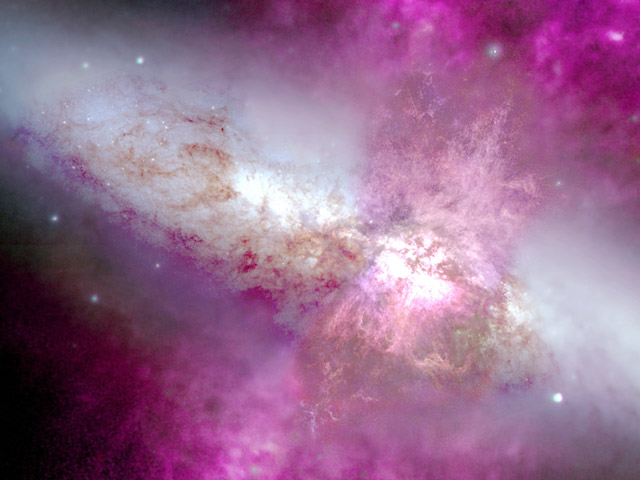
Courtesy of Astronomy Picture of the Day.Neither did I, some 25 years ago when I first wrote about M82 in a planetarium show. At the time nobody was quite sure what was happening at the center of this galaxy. It looked like it could be blowing itself apart; a stellar city disrupted by tremendous forces. Well, times have changed. We have better telescopes, stronger "glasses" if you will, and now we can look into the heart of M82 and see that it's really harboring a galactic construction site, a humongous starbirth nursery that's blowing winds across space. To be sure there's a little stardeath going on here, too. Supernovae—the deaths of massive stars—are also blowing strong winds across space, fueling the frenetic appearance of the scene. Here's what the Astronomy Picture of the Day site says about this image:
"Star formation occurs at a faster pace in M82—a galaxy with about ten times the rate of massive star birth (and death) compared to our Milky Way. Winds from massive stars and blasts from supernova explosions have created a billowing cloud of expanding gas from this remarkable starburst galaxy. The above scientifically color-coded image highlights the complexity and origin of the plume by combining a wide field image from the WIYN Telescope in Arizona with a smaller high-resolution image from the orbiting Hubble Space Telescope. M82's aspect in optical pictures has led to its popular moniker, the Cigar Galaxy. M82's burst of star formation was likely triggered a mere 100 million years ago in the latest of a series of bouts with neighboring large galaxy M81. This is what keeps me fascinated about astronomy. The better our tools become, the more we learn, and of course, the more questions we ask about the cosmos. I wonder what future telescopes will see at the heart of M82? posted by CCP on 6/04/2004 06:54:00 PM | *
6.02.2004 Calling All Pleiadeans
Courtesy Space Telescope Science Institute.The Pleiades—that little cluster of stars that makes wintertime stargazing so nice (among so many other other night-time delights) came in for some extra interest by Hubble Space Telescope recently. Astronomers wanted to determine the distance to this little grouping. It's not always been easy to tell how far away they are, and in fact their distance has been the subject of controversy among astronomers. Measurements made by the Hipparcos satellite suggested that they were closer to Earth than observers used to think. However, other astronomers measured the distance and found it to be farther out. HST's studies found the same result: the Pleiades lie about 440 light-years away from us. The image above shows the Pleiades with Hubble's field of view superimposed over parts of the cluster.
Why all the fuss? Because if those stars lay farther away (as Hipparcos suggested) their brightness wouldn't match with what we know about star characteristics (particularly sun-like stars).
It may seem like a tweak in distance measurements, but it's an important one if we are to understand how stars form and how they live. Astronomy is often like that— giving us tantalizing hints about the nature of objects and leaving it up to us to measure and chart the details.
So, if you're a Pleiadean (one interested in this glittery little set of stars, not necessarily someone who thinks you're from the Pleiades), take heart: from 440 light-years away, they're helping us understand more about stars like our Sun. posted by CCP on 6/02/2004 12:00:00 PM | *
|
Earth Hour! Do it for the Planet!
Blog RollPlanetarium-relatedLoch Ness ProductionsPurveyors of fine planetarium shows, music, and services. INTENSELY Good Space Music from a master in the genre! My cool astronomy cause: ScienceThe sites below belong to space and astronomy enthusiasts. I make every effort to check them and make sure they are still appropriate. However, I am not responsible for their content, nor do I endorse any of it by simply linking to them. As with all Web surfing, please exercise caution. Adot's Notblog A fellow traveler blogger and astronomy enthusiast! Astronomy Blog An astronomy blog pondering the big questions Astronomy Cast Astronomy Podcasting from Pamela Gay BadAstronomy.com Bad astronomy discussed and debunked along with fun stuff about really good astronomy! Chris Lintott's Universe Musings from an Oxford Astronomer. Cosmic Variance Random Samplings from a Universe of Ideas. Dave P's Astronomy blog Observational Astronomy and other TidBits European Southern Observatory Fine Ground-based astronomy images. Gemini Observatory Fine astronomy in infrared and visible wavelengths. Griffith Observatory's page. I wrote their exhibits! Observing The Sky Nightly Observation Reports from dedicated skygazers. The Official String Theory Web Site. Time to feed your mind! Pharyngula Evolution, development, and random biological ejaculations from a godless liberal. Cast off your blinders and come on in! Science Made Cool A compendium of discoveries, inventions and commentary. Slacker Astronomy Astronomy with a Slacker Twist. Space Telescope Science Institute The best from Hubble Space Telescope The Eternal Golden Braid Astronomy, Space Science, and Science Fiction Commentary. The Inoculated Mind Bills Itself as a weekly science mindcast. Thought-provoking, honest. Truth. UniqueThe Hairy Museum of Natural History
|