I'm a science writer and editor. I work with clients in the observatory and planetarium community, as well as my own book, web, planetarium, and other projects.
Need a writer/editor? Visit my services page for my projects and availability.
Note: The ads you see below and at the bottom of this page are screened for content and many fine companies do appear here. Occasionally ads I don't want DO slip through, particularly for pseudo-science, st*r-naming, ID, and other questionable sites. Please understand that I cannot be held responsible for their content. Do visit them if you wish, but as with all advertising, be logical and use common sense.
A couple of entries ago I talked about observing on Mauna Kea in 1996. I suppose I went into it with only a little bit of a romantic view of Big Astronomy Observing, knowing that it wouldn't quite be like the days of old with the lonely astronomer sitting in the cage while the selfless night assistant monitored the proceedings and moved the telescope at my command. For one thing, I knew that modern observatories use computers to position their telescopes precisely, and that most observers sit in nice, comfy control rooms and not in drafty chairs on the telescope, peering through eyepieces.
The control room at the UH 2.2-meter telescope
Our own observations on Mauna Kea made heavy use of computers to quickly capture images and do some quick processing to make sure we got what we wanted, before moving on to the next target. Our observing runs were chock full of targets: Comet Hale-Bopp, Comet Machholz, an assortment of asteroids, and just for grins toward the end of the night, we targeted a few deep-sky objects before we shut the systems down. If we'd had to go out on the observatory floor and manually position the scope for all those objects? Well, it wouldn't have happened.
Computers revolutionized astronomy and nowadays you see amateurs routinely hooking up their Dells and IBMs and other systems up to guide their telescopes. Many amateur scopes have their own onboard guiding systems, complete with star ephemeris information and more. Heck, you see them being run from laptops and Personal Digital Assistants! It's a far cry from the early days when the computers at observatories were pretty much limited to guiding the telescope for precision pointing. Today they also monitor the instruments attached to the telescopes, record data, and in some cases do what is called "pipeline" processing to get it ready for the observer who got the telescope time in the first place. It's safe to say that most of modern astronomy would be impossible to do without computers.
There are those who bemoan the loss of the "old days" when the observer had complete control of the process, sort of like a king on a throne, but I think those folks are few and far between. Far from computerization being a tool to remove power from lofty astronomers, it has democratized the process for more observers and made a great deal more science possible. Without it, the wonderful images from the Hubble Space Telescope, Gemini Observatories, Spitzer Space Telescope, the myriad amateur astronomers who turn out breathtaking work, and so many others would not exist.
Way back in the Dark Ages, before I got out of graduate school, I took a planetary science course or two at the university. Our field trips were great! We went to places on Earth that had similar characteristics to Mars. That would be deserts, volcanoes, and meteor craters. The West has these in various places, and so over the course of several trips we went to Arizona Meteor Crater, Sunset Crater (a volcano in northern Arizona), the Great Sand Dunes in southern Colorado, and the Big Island of Hawaii, where we studied volcanoes and sapping valleys.
On one of the trips to Meteor Crater we actually had permission to go into the crater to study the layered rocks and the ejecta hurled out when the incoming space asteroid chunk impacted the desert some 50,000 years ago. We were led down by the world's foremost authority on the crater, the late Dr. Gene Shoemaker. Descending to the bottom of the crater we examined each layer of rock and gleaned its depositional story. Fascinating stuff and a once-in-a-lifetime experience for most of us.
When I saw the latest "rim country" image from the Mars Exploration Rover Opportunity (currently finishing up its exploration of Endurance Crater) I felt transported back more than a dozen years to that hot, dusty day when we explored the layers of Earth's history in the Arizona desert. The scene here is so familiar that I had a strong memory of Gene's voice calling out to us across the rock faces and crumbling layers to "come see this!"
This is Mars exploration today, limited by the speed of a couple of slow-moving rovers serving as our eyes and geological tools on the Red Planet. It's providing tantalizing glimpses of an alien planet that looks so familiar, yet lies so far away. In a funny way, however, looking at pictures like this make me homesick for the wide open spaces we once explored as we readied ourselves to study Mars. I think Gene would say the same thing, but like me, he'd be champing at the bit to go there and see it for himself.
One of the things that fascinates me about blogs and blogging is the huge diversity of subjects that people write about in their daily entries. Just as I know I'm one of many folks who write about topics related to astronomy and space science, there are millions of people out there writing about everything you can possibly imagine. Some are fun to read, others are less so, but each one offers a window into some reality we might not otherwise get to experience.
About a year ago I ran across a virtual "stock exchange" in blogs called Blogshares.com. You might have noticed an icon for it over in my ever-growing list of links on the left. It's actually a game site where you can register your own blog and "play investor" by buying shares in other blogs. The stock market is not just limited to blog shares, however. Traders also seek out and purchase ideas (which are linked to blog subjects), and artefacts (which are also linked to ideas industries). It's a fascinating game to play, and I might add, a way to learn about the inexorable laws of supply and demand!
When I first joined I thought I might the only space blog registered, but it turns out there are lots of people who think "space is the place" and they blog about it! So, I got to looking around for other blog writers who chronicle a couple of my other interests—space music and planetariums.
Space music comes naturally for me, considering I'm married to and run a business with Mark Petersen—one of the world's foremost space music composers. Now, space music is a pretty "niche" genre. In most record stores it doesn't even have its own bin anymore (although it used to), so you have to look for it in the Ambient and New Age bins. Despite this unfortunate placement, space music IS thriving, particularly on the Web, where people like Mark sell their CDs and music to a dedicated following.
Space music is evocative of the wide-open spaces beyond the stars, going beyond the confines of traditional orchestral or electronic genres. Yet, it has roots in other genres: electronic music, ambient music, and I'd even say it might owe some of its existence to composers like Gustav Holst, Ralph Vaughn Williams, and Alan Hovhaness. Certainly it has come to be best known in the planetarium, where it is used to help paint aural images for cosmic scenes like starbirth areas, distant galaxy clusters, and the longed-for dream of travel between the stars. Mark takes scenes like these and fuses them with music that fits the vast spacescapes made possible in the planetarium.
Some of the blogs about space music that I've run across are quite interesting indeed, and give us a peek into this very rarefied world. There are many, many blogs to visit about some aspect of ambient, space, and electronic music. Here are three that I visited lately:
Astreaux World Blog about ambient, space, and new age music.
Now, Blogshares does have a music industry under which all kinds of ideas are swapped, so I think it would be neat to have a sub-industry called "space and ambient" music, and another called "new age" music. If that's too specialized, then perhaps these could become sub sub-industries under "Indie and Alternative Music." And, if the powers that be who run the game want a new artefact, then how about "synthesizer" since much of space music is created using these unique and facile instruments?
Of course, talking about space music brings me to planetariums, which also come easy for me, since I've been working in, with, or for them in one form or another since the early 1980s. They're fascinating facilities—capable of taking us anywhere in the universe we want to go, in a quest for an understanding of the cosmos. Now, when I talk about planetariums, I'm thinking of the round rooms with the star projector in the center. There are also planetarium software programs, which also make stars for you, but only on your computer screen. However, there are few smart folks (like Sky-Skan, Inc., of Nashua, NH), who have harnessed the computer-generated starfield programs and are using computer systems and projectors to blast them up to the dome, but those aren't in people's homes— yet. Chances are when you've been to a planetarium, you've heard space music. It was probably what made you feel right at home in space!
So, are there blogs and blog entries about planetarium space theaters? Well, yes there are. In a cursory Google search I found hundreds of entries about experiences in the planetarium, ranging from that first visit to one as a grade-school child to the absolute awe and wonder these places spark in our minds. Here are a couple of examples:
Planetarium visits seem to be a recurring theme across these blogs. While planetaria aren't things you visit every day (unless you happen to be IN the biz), they ARE a part of our landscape, and I hope they continue this way for a long time!
As far as Blogshares goes, I think that the game could use a new entry under "Media" called "Planetariums", with an artefact called "Planetarium show" and another called "Planetarium Instrument." Sure, they're esoteric, but life isn't always about the everyday things. It's also about the experiences we share in places like planetariums, where science, music, art, and the human voice all combine in new kinds of media vehicles that can take us to the stars.
Eight years ago this month I had the happy privilege of doing an observation run at the University of Hawai'i 88-inch telescope on Mauna Kea on the Big Island of Hawai'i. For eight nights I explored comets and asteroids with a small team of UH astronomers. It was a giddy experience, partly because it was my first "Big Astro" esperience, but also because we were working at 13,792 feet above sea level—a rarefied environment indeed! The image above is a great view of Mauna Kea from the space shuttle, and a wonderful reminder that no matter how high up we go to use our observatories, there's always a higher vantage point.
At the time I did my observations, the Gemini North telescope was still under construction, so we could go out on the catwalk on our telescope and look down on the site as the workers were knocking off for the day. In fact, two of us (James Bauer and I) managed to get our picture taken by a web cam that snapped images of Gemini as it was being constructed. If you look closely at the image below, you can see two dark dots on the far right limb of the catwalk girdling the 88-inch facility (the horn-shaped building up the hill from the Gemini site). That's us, waving at the camera about 30 minutes before sunset and the beginning of our "work day" on the mountain.
View of Gemini Observatory, November, 1996>
Today's view of the Gemini Observatory (Be patient—it takes a little while to load the view)
Well, life moves in interesting cycles. Today, the Gemini North Observatory is a complete, functioning facility, cranking out good science every day, along with its twin observatory in Chile. And, I've moved on from my comet research days. Nowadays I'm working as an astronomy writer, bringing the wonders of the cosmos to my audiences (whether they're reading my books and articles or attending planetarium shows that I've written). In a most wonderful development, I've also been working closely with the Gemini Observatory public relations office, helping them get the word out about all their achievements. Sometimes the cycles of the cosmos are logical, indeed!
The planet Mars gives us such a panoply of different terrains to explore with our spacecraft and rovers. The European Space Agency mission Mars Express has been returning a number of fascinating images based on mapping data from the spacecraft's instruments. Some of these are so detailed you can see features like sand dunes rippling across the floor of the impact crater Hale in the Argyre Basin of the Martian southern hemisphere. In other places we can spot flow features that look for all the world like the aftermath of a flood or a region cut by a fast-moving river of water sometime in Mars' distant past.
So, why explore Mars? The most common answer is "because it's there" is a good one, although it's tough to convince skeptics of the value of serendipitous exploration. In truth there are dozens of answers. We explore so we can learn. What do we learn from Mars? Its dry and dusty surface holds the keys to a fascinating past that included dramatic planetary reversals of fortune from wet to dry. Can we extrapolate anything we learn at Mars to our future on Earth? Possibly, but it's not clear that what happened to Mars is waiting in store for Earth. We can, however, take what we know at Earth and apply it to Mars. We know how flowing water changes surface characteristics here on the home planet, and when we see it on Mars, we know how it happened. Same with volcanic flows and impact cratering and wind-driven erosion. All those things happen here on Earth, and we know what they look like here. Find the same kinds of structures on Mars and you have a good lead as to what happened ON Mars.
That's the beauty of exploration—you learn and then you take what you know and apply it elsewhere to understand how things work in the cosmos. Mars is giving us a lot of mysteries, but it's also allowing us to do some practical planetary science, all for the price of some useful missions!
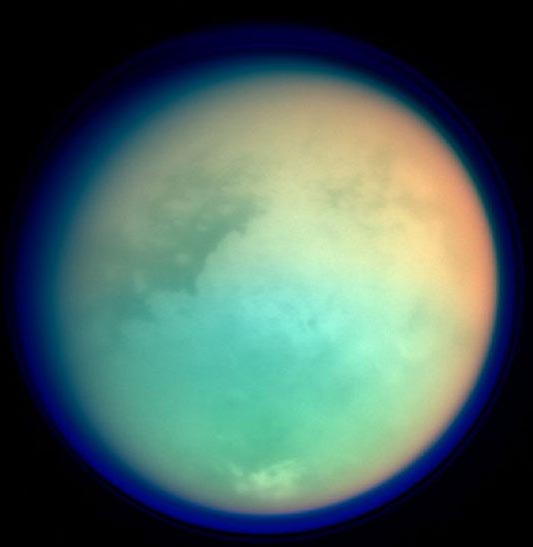
Saturn's shrouded moon Titan is coming in for an in-depth study by the Cassini-Huygens mission currently exploring the Saturn system. In order to image what lies beneath this tiny moon's gigantic atmosphere, astronomers image it in different wavelengths of light. Using ultraviolet- and infrared-sensitive instruments to gather data about Titan's surface, they were able to piece together this "peek beneath the veil." Red and green colors represent infrared wavelengths and show areas where methane in Titan's atmosphere absorbs light. Blue represents ultraviolet wavelengths and shows the high atmosphere and detached hazes.
A synthetic aperture radar image of Titan's surface.
Courtesy Cassini-Huygens Mission
Titan's atmosphere extends hundreds of kilometers above the surface. What lies beneath those clouds is the target of the Huygens probe, set to descend to Titan's surface on December 25, 2004. From this radar image, what we can see so far appears to be smooth, made of radar-absorbing materials, or possibly a region that slopes away from the direction of illumination. The striking bright feature that stretches from upper left to lower right across this image, with connected 'arms' to the East could be some sort of flowing material, possibly where water-rich liquid has welled up from Titan's warm interior. Scientists are hoping that the probe will survive long enough to give an idea about exactly what's happening on the surface of this shrouded world. Keep your eyes turned to Titan on December 25th!
Every year about this time astronomers and planetarium folk the world over (whether amateur or professional) get variations on the following question from well-meaning friends and relatives: "My niece / nephew / son / daughter / husband / wife / mom / dad / friend / boss / coworker is interested in astronomy. I'd like to get them an astronomy-related holiday gift. What can you suggest?"
It's a tough one to answer because everybody's relationship to the stars is different. The professional might think that it would be cool to get a grant extension on the current research he or she is doing, while the amateur might be thinking of his or her next eyepiece purchase!
Seriously though, it's a question we do hear a lot. I've mentioned this before in my blog entries, but I've created a little reference library and "gift shop" on my website called the Helen Sawyer Hogg Memorial Library and Gift Shop. I recommend you check it out because it has a lot of gift ideas, reviews, and links to helpful articles at Sky & Telescope that can help you decide on hardware purchases for the enthusiast in your life.
Another big question we get a lot has to do with what telescope or binoculars to buy for an astronomy-minded person. THAT is a tough one to answer because it really does require us to know just what the giftee is going to be looking at with the optics. Actually, one of my responses is usually, "Does the person you're buying this for (even if it's for yourself) know much about the sky?" The reason I ask that question is that before you go out and spend a lot of money on decent binoculars or telescopes, you (or your intended recipient) should know a little something about the stars, like how to find your way around the sky, basic constellation outlines, and some elementary star-hopping techniques.
I do have some books and star wheels listed at my little impromptu gift shop, and those are quite useful tools to help you and your friends learn the night sky. Think of it as learning to read the map before you set out on a cross-country drive in a new car. Once you know your way around—and a little about the jargon and nomenclature of stargazing—it's immensely easier to get around the sky. Then, after you've spent some time familiarizing yourself with the target areas you want to study, you can point that telescope or binoculars to them with great confidence and explore in more detail!
If you visit my reference pages you will find that I've got some telescopes and binoculars listed. I've used those pieces of equipment (or models very similar to them) and feel confident about recommending them to users. One thing you will NOT see on those pages are links to cheap, department-store telescopes. Every year you can just about bet that there will be some "deals" on telescopes that seem too good to be true. About 99.9 percent of the time, they ARE too good to be true. You'll see things like "magnifies the universe by 600X!" which, of course, tells you nothing about what it will be like to look through the telescope. They also don't tell you that the optics in these cheap scopes are likely to be plastic, or poorly made glass. If you've ever looked through a pair of dirty glasses you'll have a good idea of how the universe will look through these "deals." Finally, even if the optics WERE good in these products, they're usually connected to flimsy mounts that don't hold the telescope rock solid as you view through it. The result of buying one of these things? A telescope in the closet and a disappointed user. So, while it may cost more to buy a quality piece of equipment, it pays off in the long run with a satisfied user.
My recommendation for someone just starting out is a good book on astronomy, a star wheel to help them find their way around the sky, or software if your recipient is computer-inclined. The possibilities for exploring the universe on the pages of a good book are endless. Star wheels are easy to use and never go out of style, and software gives the user an incredible depth of knowledge from which to begin any number of stellar explorations. If they get hooked on astronomy, there's always time later on to move up to that pair of binoculars or a telescope!
Finally, nothing beats the gift of your time and presence with your intended recipient. Get that star wheel and learn how to use it with them. Read the book to each other. Let some good space music send you to the depths of the cosmos. Set up that little toy planetarium for your child and use it to do a little indoor exploring when the weather doesn't allow outdoor stargazing.
It's big universe out there, just waiting for you to explore and enjoy it!
Astronomers are some of the luckiest people in the world because they get to work in some of the most beautiful places in the world! Imagine going to work each night and seeing the beauty of the starry sky above you, and getting paid to study it! I thought of that again today when I saw this image from the European Southern Observatory at La Silla in Chile. The folks at this site have amazing views of the sky nearly year-round. This view is of the early spring skies (southern hemisphere) taken on September 14, and features a radio dish with the stars shining through it. In the distance is the 3.6-meter telescope. And, arching over the scene is the Milky Way in all its splendor.
There's something very primal about being under a night sky like this. I've only experienced it a few times in my life: for eight nights on Mauna Kea in 1996, a 3-week visit to Peru in 1986, and a 3-week cruise around South America in 2001 as an astronomy lecturer onboard an ocean liner. Each time I'd step out under the dark skies and feel as if the skies were about to swallow me up! It's an eerie feeling, yet once you get used to it, you almost feel as if you've come home to the stars.
Whether you work under the stars as an astronomer or simply enjoy them as a hobby or pastime, the night time skies are a treasure to protect and enjoy!
A long time ago I wrote a planetarium show called More Than Meets The Eye about all the things you can see in the sky if you look with your naked eye and then enhance the view with binoculars and telescopes. Everywhere you look in the night sky you can see stars, but if you magnify the view, you can see nebulae and galaxies, details on planets and in comet tails, and even small little chunks of rock called asteroids.
The Hubble Space Telescope gives us magnified views of the universe every day. In recent weeks it spotted a small asteroid wending its way through the field of view as the telescope was studying a small companion to the Milky Way called the Sagittarius Dwarf Irregular Galaxy. You can see the trail of the asteroid as it traveled across HST's view. The wavy path is not the actual path of the asteroid—it doesn't actually wander quite that frenetically. It's wandering a bit because the telescope is a) moving, and b) several different images were taken over a period of time. That's why the trail looks interrupted and not quite straight.
What I find fascinating is the field of stars and galaxies that the HST image also shows. If you look closely you'll see a few distant spirals, some edge-on galaxies, and some other blobs of light that are either too distant or too faint to make out good shapes. The scattering of stars across the top of the image is part of the dwarf galaxy the scientists were after when they took the images. It's about 3.5 million light-years away, while the most distant galaxies in the image are at least a hundred million light-years away. The asteroid, on the other hand, is about 169 million miles away from us. It's quite a panoramic view of the cosmos in one image—and definitely MORE than meets the eye!
What's the latest at Uranus? According to Professor Imke de Pater (University of California, Berkeley) and Heidi Hammel (Space Science Institute), the 7th planet out from the Sun is not the boring and unchanging planet everybody thinks it is. The weather's changing as the southern hemisphere summer at Uranus comes to a close. There are more clouds in the upper atmosphere than scientists saw when Voyager first approached the planet back in 1986. This is due to high-altitude cloud activity perpetrated by strong convection currents in the atmosphere. If you look at the planet with infrared-enabled instruments, those clouds really stand out. And, as an added bonus, there's a newly discovered dim ring to be checked out. This new one, called 1986U2R, is—like the other rings in the system—only only a single layer of boulder-sized particles thick. That's downright diaphanous by ring standards!
These discoveries weren't made with a flyby spacecraft. Instead, the Uranus observation teams have been using the Keck telescope out on Mauna Kea (Hawaii), and the careful application of adaptive optics (a method to "erase" the effects of atmospheric aberration from ground-based observations).
What's next for Uranus as the seasons change? Maybe more clouds will bubble their way up from the depths of the planet's atmosphere. Nobody's quite sure, since this is the first time the planet's seasons have changed since high-resolution telescopes like the Keck and others have been in use.
Anybody who has been a stargazer or space enthusiast for any amount of time knows about the huge array of books and products for sale out there. Once, a long time ago, I spent a great deal of my working life going through the yearly panoply of books, star charts, games, toys, software, and even some telescopes and binoculars. It was great fun, and I was always astonished at the great variety of material out there.
With great knowledge comes the experience of getting the number one most important question from friends and relatives, especially around holiday time: what can I buy for my boyfriend/girlfriend/ mother/father /brother/sister /friend/ son/daughter/cousin/ aunt/uncle/ neighbor/boss/coworker who's REALLY into astronomy??
It's a tough one to answer because we each form a unique bond to the sky and no two of us watch the stars or learn about the cosmos in quite the same way. Still, there are some "evergreen" products out there that, at least in my opinion, are must-haves for any space and astronomy enthusiast. There are classic beginners' books like H.A. Rey's "Find the Constellations" and "The Stars: A New Way to See Them" that I think everybody should read no matter how old they are when they get started in astronomy. Then there are software programs like TheSky or Cartes du Ciel that have been with me for years and across several computers.
And then there are the hardware recommendations, usually coaxed out of me by someone who just HAS to have a telescope or binoculars. Again, these are highly individualistic, and depend on what you want to look at. I always recommend that people learn the sky first and then move on to binoculars before struggling with a telescope. There's nothing more disappointing to beginner than to get a telescope but have NO idea what to do with it or how the mechanics of finding your way around the sky actually work!
I've put together a set of web pages full of MY recommendations for good products in astronomy and space exploration. They comprise books, star charts, software, calendars, binoculars, telescopes, space music, and even a little planetarium! Point your browser to: The Helen Sawyer Hogg Memorial Reference Library and Astronomy Gift Shop. It's part of my Spacewriter.com web site, which of course also includes this blog.
Whether you're looking for holiday gifts for the astro-enthusiast in your life, or birthday gifts, anytime presents, or just plain "cuz I love you" gifts, look over these recommendations. If you're interested in buying them, I've provided links to their purchase pages on Amazon.com.
Last week I attended a planetarium meeting in Detroit, Michigan. It was a chance to meet and greet many colleagues I hadn't seen in a while—and show them our latest show—Hubble Vision presentation—with the help from our friends at the Detroit Science Center and Sky-SKan, Inc.
Show presentations in planetarium theaters have come a long way since the old "lecture with a green arrow pointer" under the sky. Oh, we all still do those lectures. They can be some of the most rewarding experiences, especially if we have a motivated and interested audience. In addition to those time-honored lectures, multi-media shows are also part of the standard fare at planetaria. Many facilities use slide-projection systems and video, others use what is called "fulldome video." Our Hubble Vision show started out as a slide show, but we also produced it as a fulldome video.
We saw other shows at the meeting, and visited three other planetarium facilities during the course of 2.5 days. It was a hectic schedule for the 165 or so planetarians who attended. We also heard a number of good papers given on various aspects of planetarium presentations, and Mark gave a workshop on how to use PhotoShop and AfterEffects (both by Adobe) to get material ready to show in fulldome systems.
What do planetarium folk talk about at these meetings? Pretty much anything you can think of that helps to improve and spice up presentations. Lecture methods, science talks, production tools, and vendor presentations all make for a pretty busy conference. Peek here for the main schedule we followed.
I always get a lot out of these meetings. For one thing, it gives me a chance to check out how our shows and other products are being used and received by the client base. But, the biggest thing is the personal interaction we get with other planetarians. Whether our colleagues work under the dome full time or are vendor planetarians, there's always something to talk about!
The sites below belong to space and astronomy enthusiasts. I make every effort to check them and make sure they are still appropriate. However, I am not responsible for their content, nor do I endorse any of it by simply linking to them. As with all Web surfing, please exercise caution.
Adot's Notblog A fellow traveler blogger and astronomy enthusiast!
Astronomy Blog An astronomy blog pondering the big questions