I'm a science writer and editor. I work with clients in the observatory and planetarium community, as well as my own book, web, planetarium, and other projects.
Need a writer/editor? Visit my services page for my projects and availability.
Note: The ads you see below and at the bottom of this page are screened for content and many fine companies do appear here. Occasionally ads I don't want DO slip through, particularly for pseudo-science, st*r-naming, ID, and other questionable sites. Please understand that I cannot be held responsible for their content. Do visit them if you wish, but as with all advertising, be logical and use common sense.
While checking my daily science sources, I ran across this interactive tour of Titan at the Cassini web site. It lets you peer beneath the heavy clouds that hide this world from our view.
Titan is the largest moon orbiting Saturn and is a fascinating blend of organic materials in its atmosphere and on its surface. The Cassini mission to Saturn will pass by this fascinating place 45 times during its extended exploration. What planetary scientists are finding here may well rewrite the books on many aspects of solar system science.
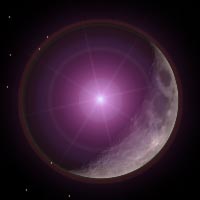
Titan as shown in composite imagery from two Cassini flybys in 2006. Courtesy NASA and the Cassini Mission.
Imagine that an astronomer announces the discovery of a new planet in our solar system. Imagine that that planet has life on it and that it may actually be intelligent life. That science is peer-reviewed and other scientists agree that there is a discovery here.
Now, imagine that a non-scientist political appointee to NASA decides that the discovery doesn't conform to White House guidelines on what science should be, and so he yanks the report and hides it from the media and public.
Imagine that a medical researcher discovers a treatment that can completely cure AIDS. It is tested and seems to work on all patients who have AIDS. Or that the doctor finds a cure for breast cancer.
Now, imagine that a non-medical political appointee to National Institutes of Health decides that the breakthroughs are "controversial" because they doesn't conform to White House guidelines about what diseases should be treated and which ones shouldn't. So, the NIH is directed (by non-scientists) stop the research and refuse treatment to people who need the cure.
Imagine that a research team finds a way to create fuels from some commonly available ingredients. The team tests it and shows that it could reduce our dependence on fossil fuels and could also help our economy.
Now imagine that a White House operative decides that this breakthrough is directly athwart political goals and therefore isn't in the best interest of the business community. And so he yanks the research and hides it.
As far as I know, none of these scenarios have happened.
Yet. But they (or similar ones) will.
Why? The White House in the U.S. is now putting non-science political appointees in agencies to control the science and its outcomes. Why? Partly so that this administration can direct science and hide anything that may be inconvenient or perceived as a threat to its ideology.
Why, that sounds very familiar. Didn't they used to do that in communist countries? Don't they still do that in some countries?
We all know what the 800-pound gorilla in the room is here: global warming. Suddenly the reports on global warming are coming out, and even as manipulated as they are by industry heavies, the word isn't good. In the U.S., the president is largely handicapped by truth and reality, and so now he must put in his operatives to control science's truths in order to effect some sort of reality that assumes that if they manipulate science, nobody will notice that things are going wrong.
Today's news stories are pointing to some inconvenient truths about acts of scientific sabotage by the Bush administration. Here are the links.
And there are more. These articles all describe a bad precedent of politically motivated ideologues in government interfering in the workings of science, and not in a good way. Would you want the government to interfere in a family member's chance for a cure? For your ability to travel to your job using clean fuels? For a scientist's discovery to be announced free of political interference? Think that interfering in science just inconveniences scientists? Think again. It's not just politics as usual. Unwarranted political interference in science harms us all for the benefit of a few.
Blogrolls are interesting things. I use mine to link to places I like to visit, and I hope you like to visit them, too. I don't always agree with every view on every blog I link to, but I do find them all to be thought-provoking and worth my time to visit when I get a chance.
A few years ago I happened across an online "stock market" in blogs called BlogShares. Instead of real-life stocks, this game trades in blogs. As you can imagine, there are blogs that talk about nearly every facet of human existence, literally from A to Z. Blogshares lists them (and gains listings every day) in categories called "Industries." A blog's value is based on how many links go to and from it. The site estimates the value of a blog and sells shares in it.
I was intrigued by it, so I listed my blog and started playing the game. I worked my way up into the top 200 players (although I'm certainly not the wealthiest player in the game), and have learned a lot about the amazing variety of blogs out there, simply by reading the blogs I've visited as I played the game. Not that I have as much time to play as much as I once did. Work and real life do have a way of intruding into game play, but I still make trades, vote on blogs, moderate votes that others make on blogs, and in general, keep my finger on the pulse of the game as I have free time to do so.
I'm not going to get into the specifics of the game; if you're interested, go check it out. But, I do want to mention how many very cool and interesting people are playing it. There are folks from around the world playing 24/7, buying and selling shares, trading in "ideas" (which are another unit of exchange in the game), and sharing their tips on how to play the game in the online discussion forum attached to the game.
When I first began playing the game, it was still being run by its inventor, a student named Seyed Razavi (who eventually sold it to the group that runs it today). He didn't actually start out to create a strict copy of a stock market so much as he wanted to explore social networking through the exploration of the blogging phenomenon by using a game to do so. He also wanted to explore how power law theories might work in human networking systems.
A power law basically says that over time, any system will evolve to favor a small subset of users/units/participants, or, in other applications, a small subset of participants or objects in a given system will consume the majority of the system's resources. You could say, for example, that when a planetary system begins to form, the largest bodies will gather in the most amount of system resources; i.e., the large planets get larger, possibly at the expense of the smaller ones.
For blogs, the power law shows that some blogs get more attention than others; they get larger numbers of sites linking to them, and so forth.
The power law distribution as applied to blogs is an interesting use of a scientific statistical tool to measure human interactions on the Web. And, Blogshares both shares in that power law and facilitates interactions by rewarding sites with more links a higher value than those with few or no links. My own blog has about 51 links to it (some from other BlogShares users), and is valued reasonably well (in the 500s per share). The sites with the most links to them, like Flickr, have very high share values (in the millions of dollars per share).
Some years ago, before the Web was a huge presence in our lives, the idea that getting on the computer and socially interacting was a new one. It's interesting that the "geeks" among us (me included) are often derided in the media for being anti-social nerds because we interact via computer networks.
But, as it turns out, the social interactions we're now doing on computer networks are following some of the same laws of interaction and social structure that we see in real life (when, for example, small subsets of our societies control 80 percent of wealth and commodities). The power law does, indeed, describe an interesting human propensity to "cluster" in our online activities, even as we do in "real life." And, for those who have been playing Blogshares and didn't know it, we've all been taking part in a social and science experiment. It reminds me of the old days, when Xerox and their PARC facility used to invite people to participate in MUD (Multi-User Domains) so they could study and model human interactions.
In that game, I actually built a home in a virtual ski area in New Mexico. I had an art gallery, a pool, a salon (wherein I invited guests to come in and debate various issues), and a front room where I interviewed guests for my home. Other people had built virtual homes in the MUD (it was called Lambdamoo), and so each personal "space" was like an extension of a person's imagination. The interactions were great fun, sometimes disturbing, and always way more than I ever imagined we'd see on a computer network way back when I first learned to program computers in high school in the early 1970s.
Of course, today we have gone way beyond the MOOs and MUDs of yesteryear to places like SecondLife, which purports to be a parallel life online. (I haven't visited it, not sure if I really have time), and forums like BadAstronomy (where all of us astronomy- and science-minded folk can talk about our mutual interests). But, it may well turn out to be not terribly different from the MOOs and MUDs, forums and BlogShares—online places where humans can network in yet another way, among the endless varieties of networks we already have. And, as it does, it will go into competition for that most valuable of resource: user time, sucking it in according to the power law that states that the most popular ones will end up taking the most attention from users. An interesting experiment, indeed!
Planets go around a star. Their treks are journeys near and far The paths are often neatly wound on loops elliptical instead of round.
What makes these orbits not quite round? The pull of gravity, it was found, battles against an object's need to cruise through space at constant speed. So, a planet's path is a tightrope dance— a deliberate trip, not happenstance.
Round and round, they go around... But now we know, they're not quite round
This poem about the orbits of planets was inspired by a talk I heard yesterday at Science and Society about how poetry can be inspired by science. The poet, Catherine Hughes, grew up in a family of scientists and found that much of her poetry was infused with themes about science. She made the case that writing about science in poetry can be an interesting, and perhaps even fulfilling, exercise.
So, I decided to give it a try. It's kind of fun to take a scientific idea and work it into poetry. It doesn't have to be perfect poetry"that's not the point. Give it a try.
I've been off attending yet another meeting the past couple of days. This one's focused on science and its role in society. There are about 1,500 of us gathered in Boston to talk about issues in science communication and the ways that scientists, science writers and communicators, museum professionals, and others can communicate the complexities of science through the various forms of media that our society is used to seeing, hearing, and reading. One of the keynote speakers the first night was former vice-president Al Gore, who is probably one of the most intellectually diverse people I've heard speak in quite a while. As you might expect, he did talk about global warming, but it's a subject he's thoroughly researched, unlike some of the so-called "experts" out there who have politically motivated reasons to promote a one-sided (read: the current administration's) view of the complex issues facing our environment. Mr. Gore gave a fascinating talk, was funny, human, and engaging. I wish we'd seen that side of him when he ran for president; we might not now be facing some of the dire issues we're having to deal with in today's toxic political environment.
I made it a point to meet with him afterwards to chat some more about some of the issues in science communication that he brought up; issues that I hadn't really thought about since my days in graduate school when I studied the same subjects from an academic viewpoint. So, it was a little like going back to a grad school seminar with an engaging professor to discuss it all with. Talking with Mr. Gore was a great pleasure and I'm glad I had the chance to do so.
But, Al Gore was only one of many good speakers we've heard since the meeting began. There have been presentations on gaming to teach science, outreach from various public television web pages, issues in medical communication, blogging, vodcasting, the future of print media, and many, many others.
It has been refreshing to meet with science folk from all over the US—indeed, some have come from Canada, Mexico, Sweden and other countries. The overriding issues are really about how we as scientists and science communicators can do a better job of bringing science to the table in social and cultural situations. The "hallway" conversations are as interesting and informative as the scheduled speakers and panelists, and it's been a privilege to attend.
I wish I could remember who said that planets are the ashes of stars; it's not quite as lovely as "We are all starstuff," but it's certainly encapsulates the process that has to occur in order to get the raw materials for planets. You start out with a cloud of dust and gas in interstellar space; some of that dust and gas is from earlier generation of stars. Some of the materials start to stick together, and then more of them. Eventually, if enough of them stick together (and I'm greatly simplifying the process), you get a world.
Once a planet is formed (ignore the fact that I've skipped over a few millions of years of accretion), the process isn't done just because the planetesimals are done banging together.
Nope, world-building continues, just in different directions and by different processes. On early Earth, there was a surface to be tended to. It got bashed in by incoming bits of stuff left over from the accretion days. In fact, everything with a hard surface in the inner solar system was cratered by incoming bits of interplanetary debris. There's very little evidence of that bombardment (which geologists call the "late, heavy bombardment") that you can see openly on Earth's surface today (unless you know what you're looking for), but you can see more obvious evidence for it in the cratered surfaces of Mercury and the Moon (for example).
Of more interest to us here on contemporary Earth are the processes of tectonism and volcanism, particularly volcanism. There are volcanoes scattered around the Earth's surface (both on the continents and under the ocean waves), and they do a good job of building up Earth's surface.
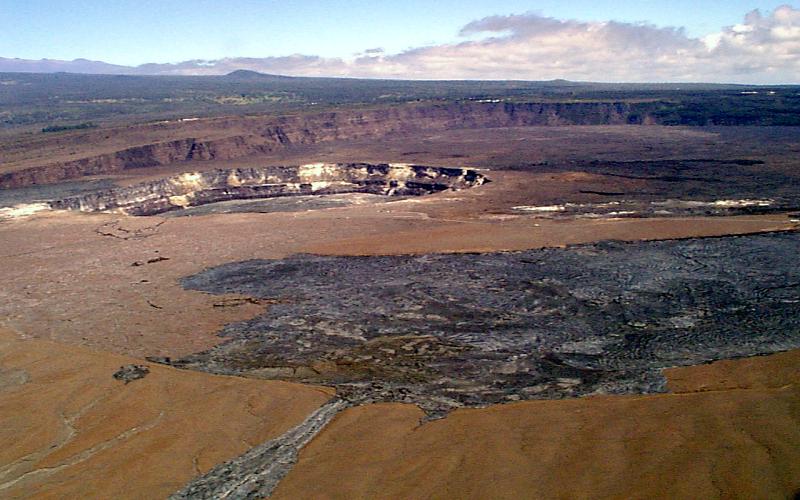
Kilauea Caldera and Halema`uma`u Crater on the Big Island of Hawai'i, courtesy of the USGS Volcano Observatory.
You can visit a place in Hawai'i where the Earth is created new each day. Lava pours out of this volcano, and under the ocean surface a few miles off the coast of the Big Island, another island is being built, entirely through the hard work of another volcano. I've hiked over the most active of Hawai'i's volcanoes and it is a sobering reminder of the creative (and destructive) forces at work in the planet-building and maintenance game. And, of course, there are other volcanoes on Earth which do a great job of re-paving the surfaces of planets and moons (think Io, at Jupiter, or the ice volcanoes of Triton and other icy moons in the outer solar system).
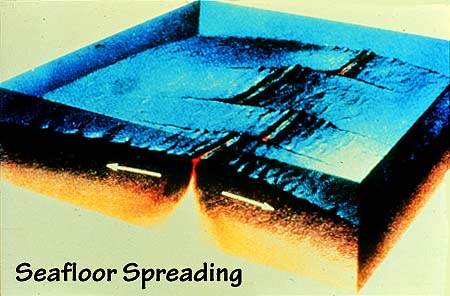
I mentioned tectonism up there... it's a short term for a complex set of actions in our Earth's crust (and on other "hard body" planets and moons, too). Essentially on Earth, the crust is divided into chunks called "plates" and those plates are in motion. You and I are riding along on a plate right now. There are dozens of plates in the Earth's crust. In some of the places where they meet we see volcanoes formed as rock is heated by the friction of two plates rubbing together. In other places one plate dives under another. In other places,they spread apart, like giant conveyor belts carrying the continents away from each other.
Seafloor spreading at boundary of two plates. For more about plate motions, read here.
Tectonics are also "blamed" for things like earthquakes, which also reshape the surface of the land. Tectonics builds mountains by shoving huge slabs of Earth's surface up into peaks. What takes them down? Another surfaces-shaping force called "erosion" (or, what planetary scientists like to call "weathering"). Flowing water, blowing winds, the action of sand on a surface—all these erode the surface on Earth. So do sulfuric acid droplets (so-called "acid rain."). And, you can see evidence of these forces on other planets. Take a look at Mars sometime and see what erosion, tectonics, and volcanism have done to its desolate surface. Or, check out some of the moons of Jupiter or Saturn. Tectonism and volcanism at work there, too.
When it comes to building planets, as you can see, the work doesn't stop when the accretion and bombardment do.
A friend was telling me about a conversation she had with a family member who criticized her for studying science when "there's so much more you could do with your life." My friend asked the family member what the relative thought she should be doing, and the response was about like this: become a doctor, or a nurse—a profession that helps people. Another choice, as the relative suggested to my friend, was to settle down and have kids and forget all about science. When my friend pushed her relative on the subject a bit more, the real truth came out: the relative said that science was against religion and that when you compared the two, religion was always better.
Putting aside the obvious contradiction that becoming a doctor or a nurse does require one to study science (actually become a scientist of the body), the idea that one can compare science and religion—even without the clearly biased opinion of the relative—seems like comparing apples and rocks. In other words, there's no comparison.
But, I got to thinking about the subtext of the relative's concerns (again, aside from the clearly sexist assumption that a woman studying science should really be home having babies, something which I've always thought is a choice best left to the woman in question), and I see another meaning here. What the relative might really have been asking is "What good is your science?" In other words, what good is astronomy? What use does it have? To a person unschooled in science, or even afraid of it, those are important questions.
But, they're also fair questions, provided you don't go around looking for answers that aren't biased for or against the study of science. It's a question that I'm sure lots of government officials and elected representatives ask whenever they see a federal budget that includes so many dollars for astronomy research.
Let's drill down a little more, though, and ask "of what use is a star?" That's something that astronomy helps us discover. And, in uncovering the use of a star, we discover links to ... ourselves!
From the surface of our planet, the star looks like a point of light. It might be part of a constellation, a star pattern in the sky.
HST Looks at Polaris
Polaris (which we all know is the North Star for at least a few thousand more years) helps us determine where north is in the sky, in essence, which direction the north pole of our planet is pointing. If we study Polaris's light through special instruments (spectrometers or spectrographs), we can tell what its chemical makeup is; that is, what chemical elements are in its atmosphere. We can also find out, as HST did, more information about its companion star.
So, in this case, a star is a pathfinder for directions on our planet, and it can tell us something about itself. As we study more stars, we find that they all seem to have some things in common: they were born in clouds of hydrogen gas, they shine (and we can measure their luminosities and use those measurements to tell us how far away they are), and they have different sizes and colors. The sizes and colors tell us something about their masses, compositions, and their life cycles.
HST studies young stars in nearby galaxy
The more stars you study, the more you learn about the environments in which they're born. What are their birthplaces? Gas and dust clouds, called nebulae. We find them throughout our own galaxy, and as the image above shows, we see them in other galaxies, too. Throughout their lives, stars enrich their environments by blowing stellar winds rich with elements into interstellar space. When they die, they recycle themselves. Other stars form from the interstellar gas and dust clouds that are left behind when a star dies. And, some of those stars form with planets around them. In our case, the Sun formed from the debris of ancient, long-gone stars. Without the remnants of star death, our star, and particularly our planet, would not have been possible. And, as you may have heard, life on our planet contains atoms that first existed in stars. As Carl Sagan once said, "WE are star stuff."
Galaxies themselves form from the coalescence of smaller galaxies (dwarfs) of stars, and each star in those galaxies goes through the same birth, life, and death processes that we've observed in our own Milky Way Galaxy.
And, the earliest stars that ever shone, more than 13 billion years ago, lit up the universe in a sort of cosmic "first light" that has been reverberating across the light-years ever since.
The technologies we use to study stars are important. Not only do they let us look to outer space for answers, but in some cases, those machines and the computer chips and sensors they use, also benefit humans in many ways. The most obvious use I can think of off the top of my head is the example of sensors built for the Space Telescope Imaging Spectrograph. It turns out they're also useful for imaging breast cancers. I find that quite poetic: that technology humans developed to look at light from distant objects is also helping humans, who are, after all, part of the cosmic dance that produces galaxies, nebulae, stars, planets, and humans.
So, of what use is a star? Look at your hand, your arm, the face of your loved one, and tell me how poor the universe would be if stars hadn't formed, lived, and died, leaving their remains to provide the building blocks of more stars, our planet, and eventually, the life upon it.
A dark cloud in the region of Rho Ophiuchi, a star that lies more than 500 light-years away. Taken by the 2MASS (2-Micron All-Sky Survey) extended mission. A larger image, suitable for your desktop, is available here.
I got sidetracked today on a planetarium show project and didn't get a chance to blog until late tonight. I got to a stopping point (I'm doing a scratch narration so we can program the show on the dome before we bring in the pro narrator) and decided to resume shuffling through the goodies I brought home from AAS.
One of the announcements I picked up at the meeting in Seattle was about an astronomical image mosaic engine called "Montage." It's aimed at the professional and high-end amateur astronomer who wants to assemble FITS images into custom mosaics. If that's your bag, take a gander at the program page. If not, then just feast your eyes on the gorgeous image of the Rho Oph region that someone used Montage to create.
The Rho Ophiuchi nebula is a cloud of dust and gas surrounding a hot, youngish star in the constellation Ophiuchus. The cloud itself has dust lanes interspersed with glowing gases lit by radiation from nearby stars. In some areas, young stars are forming deep within dust cocoons. Astronomers study this region to learn more about the early epochs of star formation, and they also survey its dust and gases to understand just what kinds of stars can form from these clouds.
Rho Oph isn't the only molecular cloud of its kind in our galaxy, but as you can see from the image above, it's certainly among the loveliest to study.
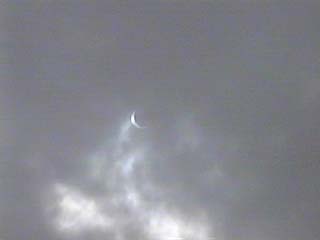
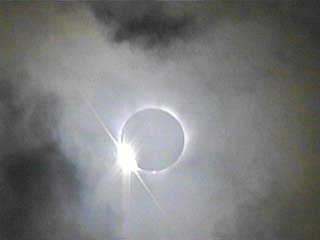
In stargazing circles, the phenomenon known as the "sucker hole" is a very real one. It usually manifests itself during eclipses and comet apparitions, and leads great numbers of people to search anywhere for a good hole in the clouds. I've been taken with sucker hole fever a few times, most notably during the 1991 total solar eclipse. We went to Hawai'i to see it as part of an expedition sponsored by the Bishop Museum in Honolulu. Our chosen viewing site was a big field in Waikoloa, and was much-touted as being on the "dry" side of the Big Island. Unfortunately, the weather didn't cooperate, which we discovered after being awakened at 4 a.m. in our Kona hotel room, pushed onto a bus, and trucked out to the viewing site. As the light of day grew, so did our horror at finding out that the sky on the supposedly "dry" side of the island was, in fact, completely clouded over. We searched in vain for a sucker hole as totality approached, and were rewarded with a few glimpses of the eclipsed Sun through some pretty gauzy-looking sucker holes. Mostly though, we just watched the clouds get dark and then light again. Ironically, if we'd stayed in Kona (which had a less-wonderful forecast) we would have seen the eclipse because that area had clear skies!
Undaunted, we pushed our luck again in 1998, when we saw a great eclipse through clear skies in the Caribbean. (You can see our pix here.)
In 1999, we decided to to try for the hat trick, so we went to Garching bei Muenchen in Germany. This time we didn't have to worry about racing a cruise ship around in case of clouds, and we swore we weren't going to drive all over the countryside looking for a sucker hole. So, we sat in a lovely "platz" outside our hotel and hoped for the best. For a couple of hours, we watched it rain. And, we searched in vain for sucker holes.
By golly, we got sucker holes. And just as totality began, we got to see the eclipse. The break in the rain clouds lasted for several minutes, and then within a half hour of the end of the eclipse, the rain resumed and we all sat around in the biergarten under umbrellas, toasting our good fortune. Others in our group were not so lucky—they chased sucker holes all over Bavaria and came up with nuthin'.
So, once in a while, sucker holes DO materialize during celestial events. We're now 3 for 5 in eclipse attempts. Our first one was in 1979, which we saw from Wolf Point International airport in Wolf Point, Montana. Our second was in Helsinki harbor, which was a sort of partial success due to low-lying clouds battling a rising eclipsed Sun. Our third was the ill-fated Hawai'i expedition; our fourth was in the Caribbean, and our fifth was Germany.
No such luck for this year's fabulous comet McNaught. We got spoiled by the Hyakutake and Hale-Bopp apparitions, and hoped to recreate the wonder of comet-gazing this year. I fear we've lost our chance to see.
Speaking of Germany and sucker holes, I got a funny story from my Google News Alerts today, datelined a few months back. It seems this German attorney is taking advantage of a law that allows kidnap victims to claim compensation from the state. He's offering to go to bat for anybody who claims to have been kidnapped by aliens. No word on whether he's got any takers, yet, but he thinks this is a growth area for his legal business. Wow.
Well, so much for seeing the comet during the day TODAY. Our little corner of New England is wet, cold, icy, and rainy. Time's a runnin' out to see McNaught, and I may have to content myself with viewing it in other people's pictures. It wouldn't be the first time, nor will it be the last. That's the tantalizing thing about backyard astronomy: sometimes you get to see the cool stuff; sometimes you don't. But, the views—when they're good—are what keeps you coming back to the stars for another helping.
I remember back in 1996 when we had Comet Hyakutake gracing the skies. No shortage of clear, cold nights THAT year. And then, later on, I had a chance to view Hale-Bopp from a variety of locations. Even though I studied comet plasma tails in grad school—and mind you, plasma tails can be VERY cool to study—the sight of those vast, sweeping dust tails was just sublime. SO otherworldly. I could stand there and think about my science AND appreciate the beauty of the night sky with a comet arcing across it. The scene in the image below is what I see in my mind's eye when I think of those wonderful comet-gazing experiences.
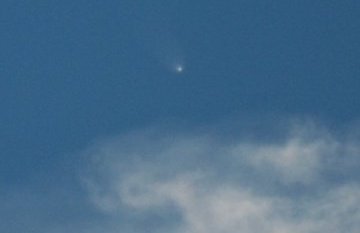
D'oh!! Why didn't we think of this sooner? A tip of the ol' Plasma Tail to Phil Plait over at Bad Astronomy for pointing out that you CAN see Comet McNaught during the day (as discussed over at Spaceweather.com.)
Let me stress that you should be VERY careful about looking at the comet, as it's close to the Sun. It doesn't take a rocket scientist to figure out that you don't want to look directly at the Sun because it'll burn your eyes. So, pay attention, guard your eyes while you feast them on the comet. Here's how: simply put a building between you and the Sun, look about one fist-width east of the Sun and you should be able to make it out. Try it over the next couple of days and hope for clear weather!
Photo by Mark Vorhusen of Switzerland, as posted on Spaceweather.com
I should point out that a photo is going to show more than a naked eye glance, but see what you can find. How many times in your life will you get a chance to spot a naked-eye comet during broad daylight?
P.S. While you're at it, check out the real-time space images of the comet at the SOHO website.
Over at Astronomy Blog, Stuart has made a list of us bloggers who reported from AAS, and along the way mentions that this is (was) Delurking Week. If you don't know, this is the week that you should be commenting on blogs that you read, rather than leaving those commmenting boxes blank and lonely. So, comment away! I won't mind.
Stuart also links to a great little vodcast created at the opening reception of the AAS meeting by the Slacker Astronomers. They went around the reception asking questions like "What size underwear do you wear" (to which Phil Plait answered "M"), and "What's the center of the universe—Earth or the Sun?"
Lots of funny answers to that one, including one from Phil (again) who promptly said, "My daughter." Of course, there is NO preferred spot in the universe, so you could say that Earth or the Sun are the center, but then again, if you were attending AAS on Alpha Centauri IV, you could say the center was there, too. At least most of the astronomers who answered knew that it was a funny question and had a good time with it.
A Questionable NASA Hire?
Normally I do not do political commentary, but occasionally a story comes across that requires a few words. What follows is one of them. I wonder what will happen to NASA now that a former second-in-command for FEMA during the Hurricane Katrina disaster has been hired as a so-called "senior advisor" to NASA administrator Michael Griffin?
In a Washington Post story, NASA spokesman David Mould said that Patrick Rhode, who started his unlikely career toward scientific policy as an advance man for the Bush-Cheney election campaign in 2000, was a good choice for the job because, "He's done a lot of things."
Some of those things include a well-circulated email that he sent to his boss during the Katrina disaster, telling Brown that he, too was sitting somewhere moussing his hair. (This while New Orleans drowned, homes in Mississippi, Louisiana, Alabama, Florida, and Texas were torn apart, and thousands of people were left homeless and at the mercy of FEMA officials.)
Our top NASA officials should have science background, along with some solid policy and technology experience. Rhode does not. It seems that the Bush administration keeps topping its own worst picks record by choosing yet another politically connected insider for a job he's apparently not-too-well-qualified-for. Rhode's background apparently includes NO science and little technology expertise, he began his career as a TV reporter (not that being a journalist is bad, and I know some science journalists who have more science background than Rhode does), and wiggled his way into a series of policy jobs that appear to have been political payoff for his support of Bush/Cheney. Okay, let's call this what it is: patronage. And,there are some jobs and places in our government where patronage hurts (think FEMA). NASA is another.
And you have to wonder why some kids in the U.S. think that NASA is irrelevant. When we see such poorly chosen officials rewarded with patronage jobs at the top of the NASA administration, it begins to look like our space agency isn't taken seriously by the administration. These people seem to operate at the center of an alternate universe where ideology trumps logic and scientific expertise. Will "Mr. Mousse" choose politics over safety as he "advises" the NASA administrator in the months to come? We don't want to see any more disasters at NASA, and we especially don't want to see loss of life, followed by a Rose Garden medal ceremony for this hack, and a "heckuva job, Rhodie" slap on the back from his political godfathers in the White House.
An interesting note: the Washington Post picked this story up late Friday (the usual time the White House announces bad news) from the Associated Press, but I see nothing on it on CNN or MSNBC or any of the other main news outlets (as of Saturday night). Let's see how it unfolds over the next few days.
Comet McNaught is fast fading from Northern Hemisphere skies (and my last good opportunity to see it is tonight right after sunset, if it isn't cloudy here). We'll give it a try, but I fear that the chances are slim, due to the immense cloud cover we have right now over Massachusetts. It never fails that when some cool astro-phenomenon is available for viewing, the skies obligingly summon forth the clouds and we see no more. Happens when there are aurora predictions, too.
What does this have to do with hobbits? Well, not much really. But, I was sitting here going through all the press releases I got at the AAS meeting (yes, I'm back in the office again after a day of reasonably good flying yesterday), and I was reading again about the dwarf galaxies that the Sloan Digital Sky Survey has discovered in their survey of the sky. I blogged briefly about the most recent one earlier in the week. But, the press release reminded me of something that happened during the press conference, a little "behind the scenes" look at what us press types experience during these conferences.
So, the astronomers who studied these galaxies described these little guys as "more like than hobbits than dwarf galaxies" (because they're smaller and fainter than some dwarf galaxies). It's a cute analogy, and being a Tolkien fan, I find the idea of some undersized galaxies being like little, hairy-footed people to be rather charming.
What struck me right away about the image of the dwarf galaxy Leo T that was the subject of their announcement was how much it looked like an ordinary star cluster as seen through a good backyard telescope. So, I decided to ask (during the Q&A afterwards) about how this sparsely populated galaxy differed from a cluster.
Dwarf galaxy Leo T as seen by the Sloan Digital Sky Survey.
As luck would have it, Rob Naeye of Sky & Telescope Magazine asked the question first, so I got to follow up with some questions about how the dark matter clumps might be constraining the growth of clusters and dwarfs.
The answer to the question Rob asked, however, turns out to be fairly simple for the galaxy we see here: its size is larger than a cluster. But, more importantly, Leo T has experienced at least two periods of star formation its history. Most star clusters have one episode of star formation and we see stars that are all about the same age. Some of Leo T's stars are now older than five billion years. But others are much younger (less than a billion years old). And, Leo T still has clouds of hydrogen gas—the main ingredient you need if you're a galaxy that wants to make more stars.
What I thought was rather interesting was that several of us in the press pool saw that picture and immediately thought "cluster!" I looked around the room and saw Martin Ratcliffe (representing Astronomy Magazine), Govert Schilling (a Dutch science writer and long-time skygazer), and Jim Manning (of the Space Telescope Science Institute, himself an amateur astronomer as well as being head of Public Outreach at STScI) all nodding our heads when Rob asked the question that must have occurred to all of us simultaneously.
I should also say that the press types who come to the AAS meetings are all very experienced science writers, with more than a few graduate degrees amongst us. There are usually 3-4 press conferences per day, and when we're not in PR events, we're out at the paper sessions and visiting the exhibit hall (which is alive with spacecraft, mission, book seller, and astronomy product sellers as well as poster papers relating to astronomy. In this meeting we also had poster papers from astronomy educators attending the American Association of Physics Teachers meeting held jointly with AAS.
I'll probably be posting a few more stories from the AAS in the next weeks. I have a few dozen press releases to mine for cool stories!
There's a law of unintended consequences that seems to operate everywhere: if you find a way to do or discover something, there's almost always another thing you can do or discover with your method. So, for example, when Ball Aerospace was developing detectors for an instrument on the Hubble Space Telescope that would look at distant objects bright in ultraviolet light, someone figured out that you could use the same detectors in another setting: to detect breast cancers. You've probably done something like that around your home—found a different use for a familiar tool. My dad used to tease us kids (I have five sisters and two brothers) that we could be fair mechanics, just using hairpins.
The image below is a shot of an array being built in Western Australia called the Mileura Wide-field Array. A consortium of groups is working on this, including MIT Haystack Observatory near my home. I've been working with Haystack on some projects, and have been following the MWA with great interest.
MWA is being built to survey the sky at radio frequencies below 1.6 GHz. What can we see at these low frequencies? Since it's located in a radio-quiet area (free of interference from our own radio, TV, satellite radio, military radars, etc.), this array is expected to see objects and events in the dynamic radio sky—the active cores of galaxies, for example, or variations in the light coming from quasars. It should be able to help astronomers detect signals from neutral hydrogen that existed back when the universe was being lit up by radiation from the first stars, more than 13 billion years ago—during a time called the "Epoch of Reionization." (You can read more technical details about MWA at the Low Frequency Demostrator array pages.
So, what unintended consequences do you think might happen as astronomers use MWA to scan the universe? It turns out that the array will be sensitive to waves of light (particularly in radio and radar frequencies) that are streaming from other civilizations around any of the 1,000 nearest stars that happen to have intelligent life on them.
Astronomer Avi Loeb (of Harvard-Smithsonian Center for Astrophysics) and a team of researchers are proposing to use MWA to search between 80-300 MHz (wherein our civilization's broadcast signals—including military radars— exist) to search for signals similar to those that WE put out to the cosmos. Dr. Loeb presented his ideas this morning at AAS, showing once again that when you build a tool for one purpose, even in astronomy, you can almost always find another equally good and pretty darned exciting use for it to make some cool discoveries. Stay tuned!
AAS-Seattle: The Astronomy Fire Hose Continues to Flow
The press conferences at AAS meetings are always featuring cutting-edge science, attended by a really good press corps with members with very good science backgrounds. I remember attending a press presentation once that presented some very exciting science and good images. The topic was on black holes and the Q&A after the main presentation reminded me of a science colloquium back when I was in research. Very probing and astute questions were asked and the astronomers were kept hopping. After it was over, I overheard one of the presenters say to a colleague, "That was like defending my thesis!"
It helps that many scientists DO get into the swing of working with the writers, and work hard to give their stories good hooks that allow journalists to make the complex stories clear to their audiences.
One of my favorite stories/headlines from this meeting (so far) came this morning. The headline is SLOAN AND THE SEVEN - make that eight -- DWARFS—Many More Predicted." The story is that with Sloan Digital Sky Survey data, a team has been able to find a number of dwarf galaxies near our own Milky Way. This is great news, but there's an underlying story that identifies dark matter (yes, that ubiquitous dark matter component of the universe) as a player in everything from the formation history of these dwarfs to their distribution (and possible links to our galaxy). It's one of those headlines that fronts a multiple set of stories, all in one press release.
Leo T, a dwarf galaxy near our Milky Way, as seen by the Sloan Digital Sky Survey.
So, speaking of cool headlines, Gemini Observatory (for which I do a lot of editing and writing work) put out a pair of press releases today. They describe some fairly complex science done with studies of rare abnormal stars in our own galaxy and a ring of warm material that is thought to be encircling the active galactic nucleus of galaxy Centaurus A (NGC 5128). The first one is Some Rare Abnormal Stars may have White Dwarf Parents. The story focuses on two types of stars that seem to have really high amounts of oxygen-18, a type of oxygen not often seen in stars.
The cute headline for Centaurus A and its circumnuclear ring was Small Warm Doughnut Feeds Theories of Extragalactic Black Holes. The story describes efforts to find a torus (ring-shaped object) around the center of this galaxy. It's there because there are emissions that imply it's there. But, no one has been able to "see" it, leading people to assume that it's smaller than we can resolve with our existing telescopes. It's important to find these rings of material because they can tell us a lot about what's happening in and around the cores of active galaxies. And, it was fun coming up with a headline that would hook people's attention to what might, at first glance, look like a story too complex to tell to a general audience. You be the judge—do the headlines help sell the stories?
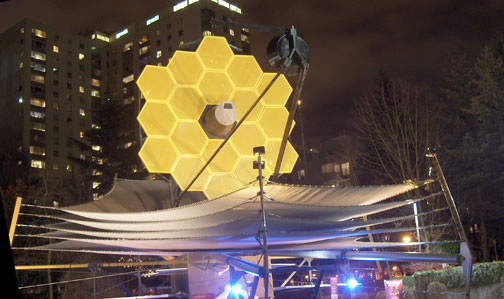
Tonight we saw one of the biggest of the future orbiting astronomy telescopes laid out before our eyes. It's an observatory we've all known is coming for a long time—the James Webb Space Telescope, set for launch in about seven years. The Northrup Grumman people (who are the prime contractors) gave a symposium tonight, presenting the science we'll be able to do with the JWST, and also a little peek at how the fabrication is going.
What's really cool is that they brought a full scale model of the telescope and set it up in a courtyard outside the convention center.
I remember back in 1988, when I was first back in school, preparing for grad school, and working on the CU half of the Goddard High Resolution Spectograph team and being majorly impressed with the Hubble Space Telescope and its future capabilities. Tonight I got a rush of that same feeling, and I can't WAIT to see what this telecope will do. If you want to learn more about this infrared-optimized telescope that will orbit at a LaGrange point and reach its gaze out to the earliest epochs of time in the cosmos, check out their James Webb Web Site.
So, what else did we hear about today?
For one thing, the first triple quasar ever discovered was presented this morning at an early press conference and then later in a paper session. The chief scientist on this venture was George Djorgovski, a professor at Caltech, and the fellow who led the team that produced the Big Picture" showcased at Griffith Observatory. I worked with George long-distance while writing the captions for the exhibits, but we'd never met in person until today.
Also presented today was a paper on discoveries of quasars in the Zone of Avoidance, a region of the sky that is "covered" by the plane of the Milky Way. It's traditionally been hard to observe through the Milky Way, but now tradition has been cast aside by a team of Korean astronomers who observed the ZOA and searched out radio or near-infrared signals from quasars through all the interference from our own galaxy. You can read their press release and see figures by downloading files from their site.
Cornell University announced that a group of observers using the Arecibo Radio Telescope in Puerto Rico discovered some unusual blasts of radiation from the Crab Nebula and its embedded pulsar. Arecibo is threatened with closure, even though it is doing amazing and productive science. It seems that the review committee that is recommending shutdown isn't aware of the contributions this dish is making, and so the story about the Crab Nebula is getting some traction here.
Finally, Hubble Space Telescope released a stunning image of a region of hot young stars that have carved out space in their birth clouds in the Small Magellanic Cloud.
These are just a few of the many topics discussed today—astronomy information is pouring out like water from a firehose. It's just amazing! Tune in tomorrow for more!
I want to try a little experiment with everybody who's reading along at home as I (and others) have our fun at the AAS meeting. Ever since I was in grad school (lo, these many years ago), I've been indulging in a little learning project that involves science press releases and news media stories. It all started when I was analyzing more than five years of Hubble Space Telescope-related stories for my graduate thesis (titled Media Treatment of Hubble Space Telescope, published in 1996, University of Colorado). I noticed a distinct disparity between the stories I was reading in the press releases coming from scientists and their institutions and the stories that were actually getting written up in the paper. For HST, at least, it was a disparity that put HST in a bad light for the first year or so after the discovery of spherical aberration in the main mirror. Gradually things changed, which I noted in my thesis. It was gratifying after I graduated to have folks at NASA and the Space Telescope Science Institute ask for my thesis so they could have my viewpoint on the issue.
Anyway, in fall of 1996, I devised a little lesson plan that I have put into effect in workshops and education sessions ever since. In it, I have people look at press releases about astronomy events and discoveries, and then I have them search out the corresponding stories in the media. I have them compare and contrast the "source material" (from the scientists) and the "outcomes" in the press. It's a great exercise in critical thinking, and along the way it also teaches science. I've taught the lessons a number of times in workshops with planetarium folk, students, and teachers in the 11 years (11 years already!!!) since I graduated. There's a conference proceedings coming out sometime this year from a presentation I gave about the technique, which outlines a full-blown four-week class I taught at Williams College last year, using college students, a planetarium, and some cool projects based on the technique.
In a sign that great minds think alike, I was talking with another blogger last night who told me she was just recently teaching a similar type of lesson with some of her astronomy students, too.
So, here's the project for you guys reading out here in blogger land: I'm going to list some links of stories released on Sunday, January 7, here at the AAS, and it's up to you guys to go read them, then search out the corresponding stories in the press to see how the "source" and "outcomes" match (or don't).
First, there's a great story on how Hubble and a series of ground-based observatories have participated in a survey of a small region of the sky in the southern hemisphere sky constellation of Sextans.
The image above shows the "cosmic archaeology" that the survey did to uncover dark matter and large-scale baryonic (normal matter) structures stretching back in time to a point about halfway between "now" and the beginning of the universe. Phil Plait has a wonderful discussion about it over on Bad Astronomy Blog. After you've read the press release information and Phil's blog, then check out how the story shows up in the media.
If you're feeling particularly frisky after that, check out some of these other stories we got press releases about today.
The scene at an AAS meeting always follows the same script of activities. The first day, we all arrive, get settled into our hotels, and then head over to the "venue" to get registered and visit with folks we haven't seen maybe since the last AAS meeting. Then, the first night is taken up with a reception that features finger food and booze. The running joke is that it's always listed as "hors d'oeuvres not to be construed as dinner." And, it's usually a LOT of great finger food. Tonight's AAS reception was no different -- but it's the first time I've EVER seen lobster macaroni and cheese on the bill of fare. It was amazing.
Well, hey. Astronomers gotta eat, too. And, it's hard work catching up on the latest missions, observations, class work, research, etc. with our colleagues.
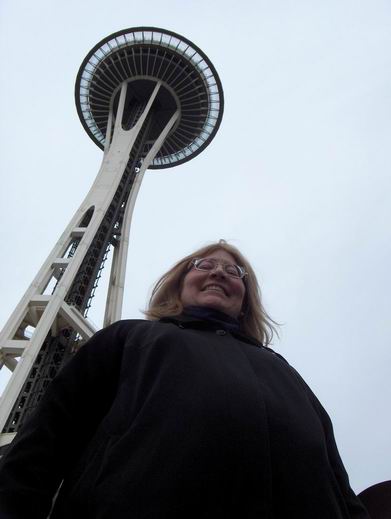
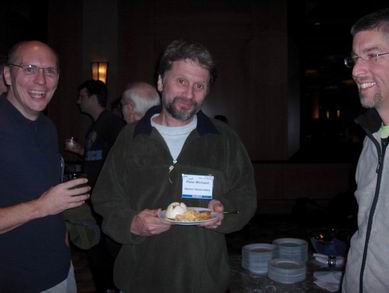
I decided to take a little time before everything got started to see a bit of Seattle. Peter Michaud (the PIO for Gemini Observatory) and I decided to walk over to the Space Needle, (the quintessential landmark of this city).
Carolyn and the Space Needle
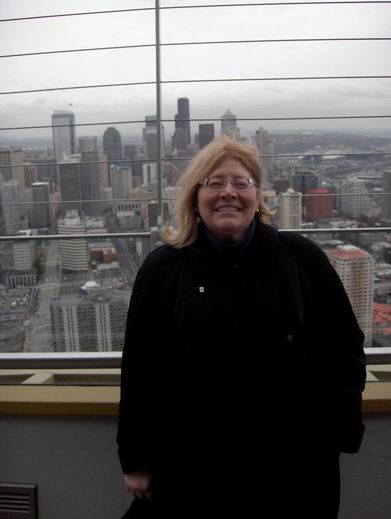
It gets pretty windy and cold up there this time of year, but does afford a nice view of the city. That visit was followed by a nice pizza and some root beer, before we headed back to the convention center. I had volunteered to help Peter set up the Gemini exhibit (and since I do a lot of editing and some writing for their observatory press releases, web releases, and other publications (they're one of my most faithful clients)), I figured it would be fun to help out.
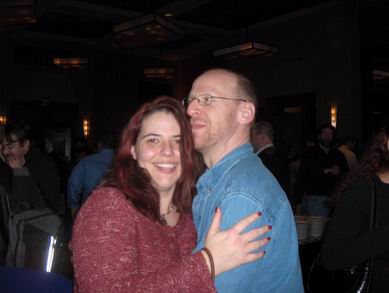
After that, it was time for the infamous AAS reception (mentioned above), where I ran into Phil Plait (the Bad Astronomer) and Pamela Gay, who is the astro-brains behind Astronomy Cast. We all geeked out in fannish admiration of each other, although as you can see below, some admired more than others (as Phil and Pamela demonstrated willingly for the camera).
Seriously though, it's always fun to get together with these guys to talk astro-blogging shop. Which we did for quite a while. Then, I circulated around the crowd a bit, finally running into Peter Michaud, Scott Fisher (both of Gemini Observatory) and Scott Isbell, the PIO at National Optical Astronomy Observatories (headquartered in Tucson).
There are more than 2,000 astronomers in attendance at this meeting; the papers and presentations start in earnest tomorrow (Sunday) and I'll do my best to bring more to you as it happens!
I'm off to Seattle for the American Astronomical Society meeting! I already know there'll be some big astronomy news released during the meeting, from new maps of the universe to new facts about neighboring stars and galaxies to a peek at an unusual set of quasars. I'm going to try blogging more actively from the meeting than I have in years past, posting more digital images along with the links to stories that I post.
While I was out running around today picking up last-minute travel needs, we happened to drive past an interesting scene on the side of the road. There was a police car, lights flashing, parked up behind a beat-up older car. Two teenage girls (possibly 17 or 18) were leaning against the guardrail, their arms across their chests and looks on their faces that telegraphed their feelings of "OH ****!" as they watched the police officers go through the stuff in their trunk. Was it a speed trap they ran across? Nope. They were obviously distressed at having been caught driving with a beer keg in the back of their car.
Old-fashioned I may be, but I couldn't help but wonder at sad scene, thinking that these young ladies should have a) been in school, and b) been studying the wonders of the universe instead of getting caught with beer they were too young to have. What a waste.
Yeah, I know that astronomy isn't the answer to the world's ills, but I wish that there was some way to keep people engaged in positive things, like astronomy... or art... or anything that would keep them away from stuff that just gets them in trouble before they're old enough to appreciate the cosmos.
Everybody's doing their top ten lists of cool things in astronomy in 2006, and since Phil Plait (aka the Bad Astronomer) posted the definitive list of top ten astro pix, I'm going to look ahead to my top ten things that I hope we'll see, learn, and do in the new year.
1) I hope we'll see more pictures like this one, showing seasonal frost on Mars as seen through the Mars Reconnaissance Orbiter's Imaging Spectrometer at three infrared wavelengths. Why infrared? Because it shows surface brightness of ices and also measures absorption spectra to tell us what those ices are made of. This image was taken at midwinter in the Martian southern hemisphere, and shows an area in the Terra Sirenum region.
2) I hope we'll get closer to the next Hubble Repair Mission, currently slated for the fall of 2008. The observatory is operating in two-gyro mode (which stabilizes it during observations, but puts more wear and tear on the remaining gyros), and needs repairs to several vital systems. In addition, Hubble will get two new instruments, the Cosmic Origins Spectrograph and the Wide Field Camera 3. This new year will be a crucial one for shuttle missions, so I'm hoping for the best!
3) As always, I hope that funding for astronomy research continues with healthy growth, rather than the stagnancy we've seen in recent years. While I know that there are many things that compete for funding in the United States, there is no science that directly or indirectly touches hearts and minds like astronomy. I've often told people that astronomy is a gateway science to so many other science disciplines: physics, math, biology, chemistry, computer and information technology, and engineering. And, we NEED more scientists in the world if humanity is to progress. I want to see 2007 as a return to the "fun" and beauty of science that so many of us learned in the 60s and 70s (giving away my age there).
4) In addition, I hope that 2007 will see a renewed interest in appreciation of science for what it is, and not what certain religious and political fundamentalists want to turn it into (i.e. a tool to glorify a religious figure or idea at the exclusion of other faiths or moral codes) at the expense of logical, clear thinking. Without getting too specific, I just want to say that it's about time we started teaching science for what it is, without ignorant interference from religious fundamentalists. Religion has NO preferred place in the range of human thought and capability, just as it has no exclusive hold on scientific truth. Nor does politics. 'Nuff said.
5) I want to see more people get turned on by the tremendous work being done in the wavelengths of light we can't see with our eyes. There is wonderful work being done by folks at the Spitzer Space Telescope, the the National Radio Astronomy Observatory, the Chandra X-Ray center, my friends and colleagues at Gemini Observatory, (for whom I edit and write outreach materials), and many other observatories around the world. Visit one each day!
6) Along that line of thinking, I hope that NASA and ESA and other space agencies will continue to push for renewed interest in space and astronomy. I read recently that NASA, in particular, is concerned that its vision is lost on the Web generation. I've also heard through the grapevine that the current NASA administrator is not so bullish on educational outreach. If that's true, it's sad, but reversible, with imagination and outreach. I hope it's not true.
The International Space Station from the shuttle on its December 2006 mission
7) I look forward to learning more about conditions in the very early universe. Studying the origins of the cosmos combines physics, astrophysics, chemistry, and high-energy physics into a Big Bang of science. It's fascinating to think of everything we know and love having its beginning in a tiny pinpoint of "stuff" that was sent on a great expansion of space and time to create the cosmos we know today. It's an epic saga.
The first stars as they may have appeared at their formation, some 400 million years after the Big Bang. (Courtesy The Wilkinson Microwave Anisotropy Probe image gallery.
8) I hope that we see more planetariums open than close in 2007. The world is long overdue for a wave of new science center and planetarium openings, as well as re-openings and refurbishings, like the Griffith project (where I got to work on wonderful exhibits and work with good people throughout 2005 and 2006). If we work together to bring a renaissance in science centers, we can create more places where anyone can go and learn about our cosmos.
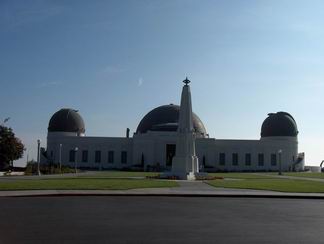
Griffith Observatory reopened in 2006 to continue its 75-year mission to turn visitors into observers.
9) I hope that we find a way to understand the climate changes our planet seems to be undergoing. We're long past the debate stage about what's causing it; what we need to do now is make sure that humans are no longer one of the main causative factors.
Earth from the Moon, Apollo 17 mission. The famous "Blue Marble" in a new setting.
10) Finally, I hope that we make some huge new discovery in astronomy this year, something that will knock our socks off. Not everything has been discovered, or understood. That's the beauty and logic of science: there's always something new to find and explain in our cosmos.
Happy New Year all! And thanks for reading me all these years. I've got cool, new astronomy-related projects to work on for my various clients in the new year, and I look forward to sharing them and many more astronomy and space science-related thoughts with you in 2007.
The sites below belong to space and astronomy enthusiasts. I make every effort to check them and make sure they are still appropriate. However, I am not responsible for their content, nor do I endorse any of it by simply linking to them. As with all Web surfing, please exercise caution.
Adot's Notblog A fellow traveler blogger and astronomy enthusiast!
Astronomy Blog An astronomy blog pondering the big questions