A Stellar Nursery in M16 -- the Eagle Nebula
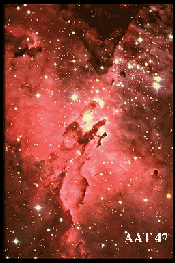 This is an image of the Eagle Nebula taken by David Malin at the Anglo-Australian Observatory. It was originally posted on the Students for the Exploration and Development of Space Home Page (see the Reference Library for a link to this wonderful site. Thanks to Bill Arnett for information on the image). |
|
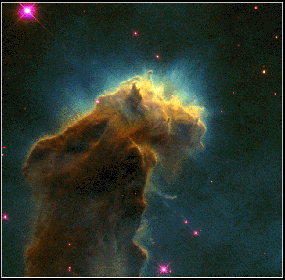
"Stars are like animals in the wild. We may see the young, but never the actual birth, which is a veiled and secret event." Heinz R. Pagels Starbirth has long been one of the most fascinating topics that astronomers can study. We've found stellar nurseries scattered across the sky, and each has its own distinct characteristics. The Eagle Nebula, seen above, is certainly a unique and beautiful nursery -- a giant molecular cloud where stars are being born. It is called a "nebulous cluster" in Burnham's Celestial Handbook, and is also known as M16, or the 16th object in Messier's catalog of nebulous objects. It lies about 7000 light years away in the constellation of Serpens. Burnham calls this an exceptional wonder of deep-space, and introduced the name "Star-Queen Nebula" as a way to express his appreciation of the region's beauty. The nebula is certainly majestic-looking enough, with a throne-shaped pillar of darkness outlined against the rosy glow of the surrounding clouds. That pillar, and others throughout the nebula, are dust clouds where newborn stars incubate in shrouded mystery over millions of years. |
  |
|
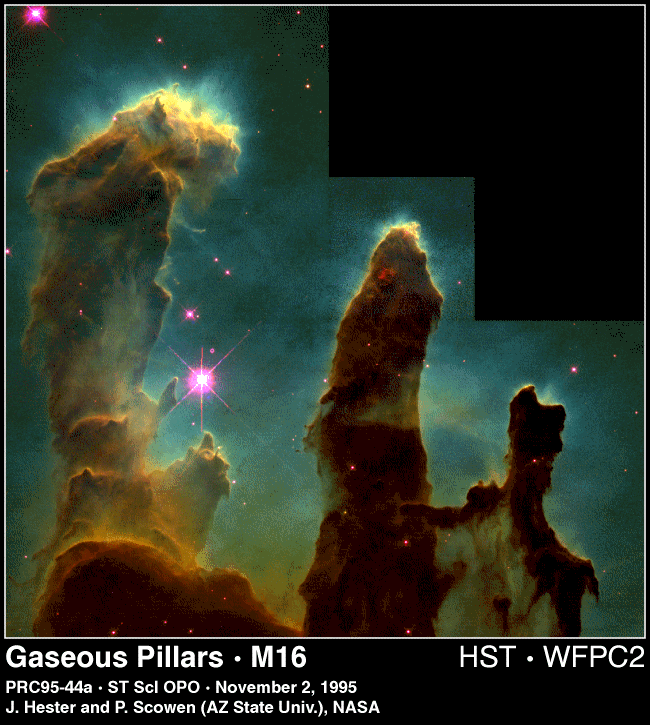
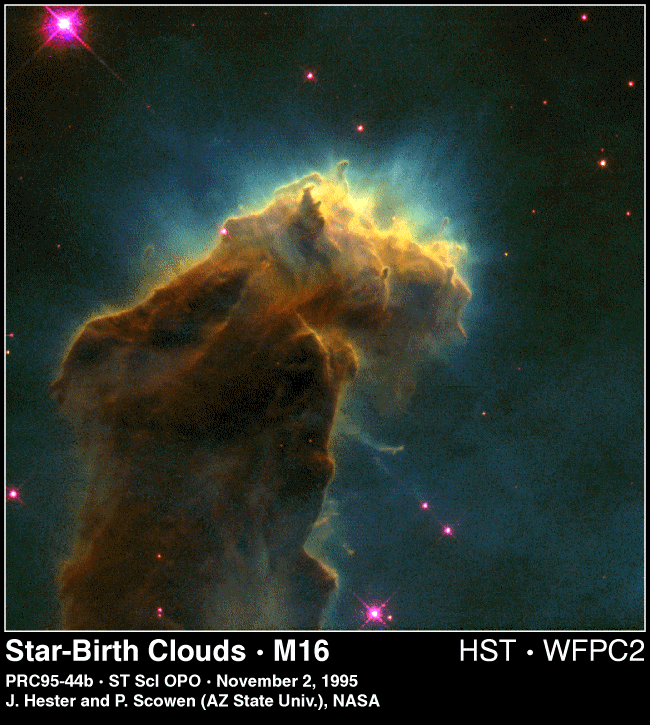
On April 1 1995, the Hubble Space Telescope's Wide Field and Planetary 2 camera zeroed in on the Eagle's pillars, looking for newborn stars. Each of these two images were constructed from three separate images taken in the light of emission from different types of atoms in the nebula. Red shows emissions from singly-ionized sulfur atoms. Green indicates hydrogen and blue shows light emitted by doubly-ionized oxygen atoms. So, what are we looking at here? According to the scientists who did the study, these pillars are somewhat akin to buttes in the desert, where pillars of volcanic rock are left standing after all the sand has eroded and blown away. In this nebula, the pillars are dense clouds of molecular hydrogen gas and dust that have survived while surrounding gases have been evaporated in the glare of ultraviolet light from nearby hot massive newborn stars. The ultraviolet light is also responsible for illuminating the surfaces of the pillars and columns, sort of like a set of celestial stagelights. As the pillars erode away, objects known as Evaporating Gaseous Globules -- or EGGs -- are uncovered. Within some of these EGGs are embryonic stars in the very earliest stages of formation. In the image on the right, we see the eerie-looking dark structure with a few finger-type structures pointing away from it. At the tip of each "finger" lies an EGG containing a stellar embryo. The pillar is illuminated by the light of a star just out of the field of view. Eventually the clouds of gas and dust that form these clouds will burn away completely, and the EGGs containing the stars will evaporate -- leaving behind the emerging star. For the scientists who research starbirth, this is one of the most exciting -- and beautiful scenes of star formation they could have hoped to find. Ongoing investigations of these clouds will uncover more birth scenes, giving us all a peek into the powerful forces of creation at work in the universe. Note: Full-sized images of these two are available. The one on the left is M16Full.gif and the one on the right is M16WF2.gif. Beware -- they're big files: 168k and 242k respectively. To go back to the gallery simply close this box. |