I'm a science writer and editor. I work with clients in the observatory and planetarium community, as well as my own book, web, planetarium, and other projects.
Need a writer/editor? Visit my services page for my projects and availability.
Note: The ads you see below and at the bottom of this page are screened for content and many fine companies do appear here. Occasionally ads I don't want DO slip through, particularly for pseudo-science, st*r-naming, ID, and other questionable sites. Please understand that I cannot be held responsible for their content. Do visit them if you wish, but as with all advertising, be logical and use common sense.
This plot of infrared data, called a spectrum, shows the strong signature of water vapor deep within the core of an embryonic star system called NGC 1333-IRAS 4B
Stars emit light (electromagnetic radiation) and heat. If you take the light from a star and send it through an instrument called a spectrograph, you can essentially break up the light into its component colors (wavelengths). You've seen one form of a spectrum in nature: it's called a rainbow and it was created by light being broken up through a prism of raindrops.
The image above is a graph spectrum showing us the chemical elements that exist in a star called NGC1333-IRAS 4B. The infrared light was analyzed by an instrument aboard the Spitzer Space Telescope (which is sensitive to infrared wavelengths). The scientists compared it to a model of a water spectrum, and found water vapor in the region surrounding the star. What they think is happening is that ice particles in the surrounding environment are falling toward the star. When they hit the disk of gas and dust around the star, they heat up and melt, forming water vapor.
These details are in the spectrum, which tells us about the motion of the ice particles surrounding the star.
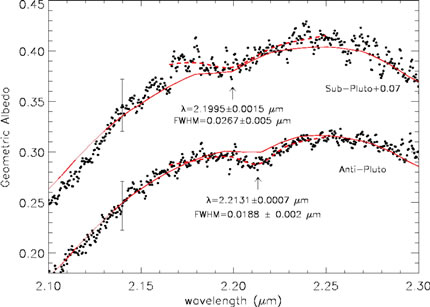
Spectra are a part of astrophysical research that can look pretty boring or confusing to people who don't see them every day. Yet, if you know how to read them and what to look for, they can reveal details of an astronomical object that you just can't see with the naked eye or in an image. Here's another one, from a recent Gemini Observatory press release, that shows the evidence for water and ammonia ices on Pluto's companion world, Charon. It is centered on infrared light radiating at 2.2 microns. The solid line is a model of a surface with ices called ammonia hydrates, along with water ices. Other dots are the data from the surface of Charon that represent ammonia hydrate ices. (You can read more about this one here.)
Now, I don't normally "do" spectra in my planetarium shows, mostly because they require more explanation than we often have time for. But, they are treasure troves of information, hidden right before our eyes.
There's another meteor shower coming up in a week, and if you didn't get enough of them with the Perseids, you should check this one out. It's called the Aurigids, and it's supposed to be a flurry of bright and oddly colored meteors that seem to come from the direction of the constellation Auriga.
There's quite a bit of interest in this year's shower, which is the debris from Comet Kiess (C/1911 N1), because it's a rare one. Comet Kiess has only visited this end of the solar system twice in the past couple of thousand years, and so Earth rarely encounters its debris tail. This year we'll plow right through that trail on September 1. And if we're lucky, there could (emphasis on the "could") be a nice meteor shower, with perhaps a hundred meteors per hour or more, if the debris stream is thick. Or, if the debris stream is thin, the shower could be a bust.
The catch here is that the peak of the shower will be best seen by people living in the Rocky Mountains and further west. Earth will be smack in the middle of this stream at 11:36 UT (that's 4:30 AM PDT). That's the peak time; the shower (if there is one) begins well before that.(See here and here for more information.)
If you are planning to watch for Aurigids, there's a unique project brewing that you might want to be involved with: the Aurigid Laptop Meteor Observation Project. Essentially, it's another distributed computing project that will take observation info sent in by people in the observing range of the shower and turn it into a three-dimensional map of the debris stream from Comet Kiess. If you've got the time, you're in the right place, and want to make a contribution to solar system science, here's your chance.
Here's a pet peeve of mine, but with a little background. I read a lot of science press releases each week, and many more science stories from various online (and tree-based) sources. At least one (and usually more) of those sources winds up saying something like, "Scientists believe that... " in an effort to get across the idea that the scientists are describing a discovery or knowledge they have about a given topic of research.
What bugs me about that usage is that it isn't correct, particularly when it gets applied to some facts that scientists (doctors, physicists, chemists, biologists, etc.) are trying to get across to the public. The writer should have said, "Scientists think... " or "Scientists know... " or something that indicates definite knowledge, not hopeful belief. (Unless, of course the scientist in question says, "We believe we can find the cure for cancer in this generation." That IS a correct usage.)
What bugs me about "believe" vs. "think"? It's sloppy language usage. Here's the Dictionary.com definition for believe: "to have confidence in the truth, the existence, or the reliability of something, although without absolute proof that one is right in doing so: Only if one believes in something can one act purposefully." (Italics mine.)
Here's the definition for think: "to have a conscious mind, to some extent of reasoning, remembering experiences, making rational decisions, etc.; to employ one's mind rationally and objectively in evaluating or dealing with a given situation."
Using the word "believe" puts in an element of uncertainty that often is at direct odds with what the scientist actually said or has discovered. Using "think" or "know" expertly expresses exactly what the data support. Let's explore that a bit.
Let's say that a planetary scientist discovers a new planet in the outer solar system. That discovery is written up in a press release and the scientist says, "We know from our spectra that the surface of this world is made up largely of water ice." It's absolute fact, he or she knows it, and after we read the story, we know it. We can look at the spectra and the data is right there, telling us that the surface has water ice on it.
Yet, often enough, I'll see the news stories based on the press release (and even interviews with the scientist), and somewhere in the story, the reporter writes, "The scientists believe that there's water ice on the surface of this new world." (Or something like that.)
No. No. No. There's no "belief" about it. It's a fact. Go back up and read that definition of "believe" again and think about it. Saying "believe" is simply the wrong language to describe a scientific certainty. Now, if you wanted to say something like "Bobby believed that the Big Dipper was his favorite constellation" or "The Elbonians believed in the myth of Atlantis" that would be entirely proper because then there IS confidence in some truth or reliability of some information but there's no data or proof of the stated belief.
It's a fine point, but one that we should all pay more attention to, because science does deal in precise language and measurements. "Belief" is not part of the scientific process, but having factual knowledge is.
Or here's another way to think of it. I'm a science writer, I have a degree in journalism, I work as a freelance editor, and I have experience working at at a magazine and a newspaper. Therefore I know something of how these professions work. It is entirely right for me to say, "I know that newspapers work on deadlines" because I experienced it and it goes on to this day. I also know from my experience that editors change stories that reporters turn in for publication (or that they get from press releases). They do this for many reasons, but usually to tighten them up or replace repeated words, or to clarify something.
For example, a writer that I once edited used the word "that" as much as possible. However, it gets tiresome to see the same word over and over again, so as an editor, I looked for words to replace "that" to help the meaning along. So, if I see a story where the word "believe" is substituted for the words "think" or "know" when referring to something that scientists DO think and DO know, I would be absolutely correct in saying, "I believe that the editor substituted the word "believe" for the word "know" because the writer may have used the word "know" too many times." I could also just as easily say "I believe the writer used the word "believe" because he or she didn't know better."
I can't say that I "think" the editor or the writer did it because that would imply that I have direct knowledge of what that editor or writer did. But, I can say that I "believe" it happened, because while I don't have direct knowledge, I do have a pretty high confidence level that it happened.
Pedantic, yes. Correct, yes. Science writing demands as much precision as the subject we're writing about. I don't believe that. I KNOW it.
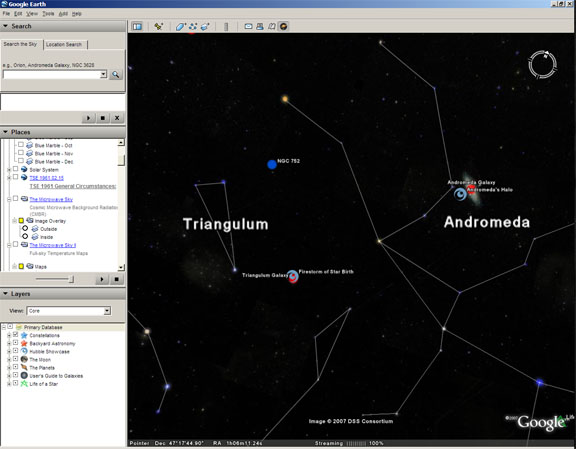
Just when you thought Google had covered just about everything here on Earth, they've come out with a cosmic exploration tool accessible through Google Earth. To get it you have to download and install the latest version of Google Earth 4.2 (available for PC, Mac, or Linux).
Laid out before you are stars, nebulae, and galaxies (including some of the most distant ones ever seen), all accessible through the same navigational tools as regular Google Earth. You also get constellations and a whole Backyard Astronomy layer, complete with images as seen by naked eye and telescopes. Hubble Space Telescope imagery, and two informative layers about the life of a star and the users guide to galaxies complete the opening set. I can imagine that once people get hold of this and play with it for a bit that there will be a blossoming of .kmz files (the overlays) out there for all kinds of tours and educational trips through the cosmos.
This is one of those times in the development of the internet and the World wide Web when I look back over how far we've come. The first computer I ever used was a mainframe that our high school had access to from a local research establishment. We programmed it in BASIC, although the advanced types could do FORTRAN or COBOL. The output? Paper printouts. The first computer I ever owned was an Osborne Executive that Mark and I bought in the early 1980s. My first modem followed shortly thereafter. The output? Paper printouts. On the screen it was all ASCII.
In record time we went from that tiny 128K machine to Kaypros and Dells, each one bringing us more and more capability for office apps, plus access to content on what was becoming the Internet. Today, almost a quarter century later, we're reaching out to the cosmos with Google and other accessible tools. The other night I was watching movies on my computer and had to stop and marvel for a second about how commonplace it all is now. But, 25 years ago, not so much. If anybody had told me then that I'd be accessing images from an orbiting space telescope, using my computer and a network to send my work to clients around the world, and exploring the distant cosmos with a program that made it as easy as a mouse click—well, I wouldn't have believed them.
For those of you who have grown up with the wonders of the Web and Internet at your fingertips, it's all as new as today. I think it's great and now I'm going to stop reminding myself about the distant past. The future's here folks. Enjoy!
Now, go download the new Google Earth and get to work exploring!
Back in August, 1981 I took a trip out to California to be at the Jet Propulsion Laboratory in Pasadena to watch and learn as the Voyager 2 spacecraft made its closest approach to Saturn (and various moons and rings). It was a pretty major event in my life; it's what turned me toward a life of science writing. I was working at The Denver Post at the time, and had talked the managing editor into letting me go out and cover the event (even though I was a newly fledged editorial assistant at the time). I think I must have told him that I'd represent the paper well, because he handed me an accreditation letter, patted my hand (which was sort of the editorial equivalent of chucking me under the chin, I guess), and told me to go out and have a good time.
A week or so later, I landed in Los Angeles, and proceeded to have the time of my life. JPL was sort of a "Holy Grail" site for me. I remembered reading about it during the Moon and Mars missions, so I couldn't wait to get there and start watching planetary scientists in action.
So, there I was at JPL's von Karman Auditorium and press site, with a desk and phone and press credentials, watching as folks like Carl Sagan (one of the people who showed me that science writing could be fun) would walk by, visiting with the press or talking with fellow scientists about what they'd seen so far.
Many of the press folk attending the week's press conferences were experienced science reporters. A few, like Kelly Beatty of Sky & Telescope, the folks from Astronomy Magazine, myself, and others, had some astronomy and/or planetary science background. In fact, some were SO experienced that they could make some initial science diagnoses about the pictures at about the same time the scientists themselves were figuring just what the heck we were seeing in the images. The image interpretations (called "instant science") were flowing freely, and the many successful press attempts to figure out the images led one scientist to dub the science press as the "von Karman imaging team" as a sort of tribute to our interest and expertise.
One of the most enduring memories I have of that week (and there are many!) is the evening that images from the moon Enceladus were due to come in. It also happened to be the night that Ted Koppel was going to broadcast "Nightline" live from the von Karman Auditorium at JPL. The press rooms were crawling with several hundred print and TV journalists from around the world, and most of them worked diligently during the day to get their stories filed by late afternoon. By evening all of us who weren't on TV would sit around and watch the TV folks from the east coast do their standups and live interviews. That is, when we weren't glued to the closed-circuit TVs around the place that showed a constant stream of images from Voyager 2.
Anyway, that night, we were watching as Ted put on his makeup and his entourage of directors and camera people bustled around getting things set up. Just as Ted and the bunch were about to go live with their broadcast, images of Enceladus started streaming onto the monitors. Immediately we were all drawn to them, and a bunch of us were clustered around one of the monitors (the von Karman imaging team AND Voyager imaging scientists who happened to be nearby) arguing over just what the strange markings on the moon's surface could mean. It was a free-for-all of image interpretation, planetary science "jousting" and pure astonishment at the amazing level of detail we could make out in the images. I remember standing next to Brad Smith, who was one of the Voyager planetary science team members, listening to him describe the processes that could have formed those strange cracks on the surface.
Well, we'd pretty much forgotten about the "Nightline" folks in our frenzy to look at the images. Not that they cared about us print folks. But, they DID care about having a quiet set, and apparently we were interfering pretty badly with Ted's opening monologue. One of his assistants came over, huffy and waving papers and hissing at us to keep it down.
We did, for awhile. But, as the pictures kept streaming down, our excited discussions got pretty loud again. At one point, Ted chuckled and said that the excitement level was quite high, one of the major understatements in the history of press conferences.
It's amazing to realize that 26 years have gone by since that wonderful, exciting week. I, of course, haven't aged a bit, although my science writing has steadily improved over the years. That visit to JPL is, as I said, what launched me as "TheSpacewriter" (although, at the time, I wasn't quite so audacious as to call myself that), and eventually sparked my interest in going back to school to study more astronomy and planetary science. And, another degree, a couple of major science research projects, some books, a magazine editorship, a bunch of planetarium shows and documentaries, a major science exhibit project, an upcoming vodcast series, and countless other projects later, here I am looking back with great fondness on the mission that set me on my way. So, here's a tip of the ol' scan platform to Voyager 2 and the planet Saturn for being there at the beginning of my own trajectory into astronomy and planetary science!
Some years ago I wrote a planetarium show for the Springfield, Massachusetts facility about the search for life in the universe. The show, which Mark and I sell through Loch Ness Productions, is called Oceans in Space. In it, we talk about the formation of life on our planet, and then look around the solar system for other places where the basic needs of life (water, warmth, organic material) could be met. We implied that some of the frozen water worlds of the outer solar system, like Europa, for example, could be considered as likely places where life might get a foothold.
Another world often discussed as a possible life-bearing place is Enceladus, one of the larger Saturnian moons. It shows a number of different kinds of surface units (five terrain types, if you will), including areas that are clearly recently resurfaced from within. That means that something is heating Enceladus from within, forcing fluid to ooze out over the surface (or, possibly as ice geysers) and refreezing (which would cover up any craters or cracks that existed there).
The tortured surface of Saturn's moon Enceladus belies ongoing geological activity.The enhanced color view of Enceladus seen here is largely of the southern hemisphere and includes the south polar terrain at the bottom of the image.The south polar terrain is marked by a striking set of 'blue' fractures called "Tiger Stripes," and encircled by a conspicuous and continuous chain of folds and ridges. Planetary scientists are still making models to explain why this moon is so active.
Since heat is one of the "feeders" of life, and there's heat generated inside Enceladus (likely from tidal heating caused by gravitational squeezing), and there seems be water on (and in) Enceladus, it would make sense that life could exist on (or in) that moon, provided that life had some sort of food (chemical or biological) to feed on.
Well, as it turns out, Enceladus may not be as water-rich or hospitable to life as scientists thought. New models of this moon's interior, based on data supplied by the Cassini spacecraft in orbit in the Saturn system and discussed in this press release, suggest that maybe what we're seeing on this moon's surface may not be driven by the action of liquid water inside the moon. Instead, it might be caused by what researchers call the "dissociation of clathrate ices." Clathrates are ice compounds in which one kind of ice (say, water) is imprisoned in a matrix of another kind of ice (ammonia or methane, for example). In this case, Enceladus may well have a heat source that only needs to heat the ice a little in order to melt the ice shell. The release of some gases in the process would be enough to send plumes of material out and re-coat the surface. This may mean that there's less water on Enceladus than scientists previously estimated.
This isn't a kiss of death in the search for life in our solar system. It just means that one of the main components necessary to help life along on Enceladus isn't so abundant, making that moon less hospitable to life.
What I like about this story is that the finding IS a confirmation that the observations we're making over the long term in the outer solar system are teaching us about the mechanisms that shape those worlds, including the roles of other chemical and geological processes in icy worlds. And, just because those worlds MIGHT be able to harbor life doesn't mean they actually HAVE life—a distinction that I rarely see made in media reports about the search for extra-terrestrial life. It's one thing for a world to have the capability to sustain life (or even have the conditions where life could form). It's quite another to actually prove that life exists there. To do that, we have to see the life and we have to understand the complex chemical and geological conditions that exist there.
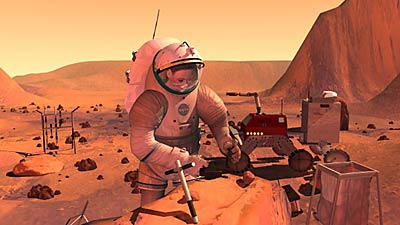
Somewhere out there, the first Mars explorer is getting ready. I often wonder who it will be. A young woman from the U.S.? A man from Africa or Europe? A member of a multi-national team that spent years living and training on Earth and then the Moon?
The state of Mars exploration today is largely dependent on orbiters and landers. This is as it should be. These workhorse robots are doing the advance work for future generations of human explorers. Due to the work that the Mars rovers are doing, for example, future Mars geologists (areologists?) will know what to look for when they study the rugged terrain and now-familiar rocks on the surface of the planet. The mappers will have given us the most detailed surface maps, suitable for charting out the course of human exploration of the Red Planet. Even the Hubble Space Telescope comes in for some Mars exploration, charting long-term changes of the planet as seen from Earth orbit.
Eventually, however, humans will figure out the mechanisms for getting to Mars, exploring it, and living there for long periods of time. That will be, as a friend of mine at NASA once said, "time to quit messing around and actually DOING the heavy work of Mars exploration." (Well, he didn't say "messing around" but you get the idea. He IS a supporter of human exploration of Mars, even as he recognizes the need for precursor robot explorations.)
Science fiction writers have long explored Mars. One of the most realistic depictions of life on Mars comes in the book Mars Crossing by Geoffrey Landis. It's a very scientific look at the very human enterprise of exploring Mars. The attention to detail gave me a few "I didn't know that" moments, such as the fact that due to the heavy hydrogen peroxide content of the Mars surface and atmosphere, visitors who are exposed to it (and it would be inevitable on a long-term exploration) would find their hair bleaching out! Who'd a thought Mars would be the ultimate hair salon!
Blonding hair notwithstanding, human visitors to Mars will be profoundly changed by the experience in many ways. Witness the life-changing experiences that astronauts who have only visited the Moon and low-Earth orbit have described when talking about their work in space. I can only imagine our first Mars explorer standing there on the new frontier, looking around the dusty, desert surface, and then searching out Earth in the night-time Martian sky. It won't be much larger than that famous "pale blue dot" that the late Carl Sagan was so fond of describing. I wonder what they'll say when faced with the enormity of the distance they've traveled? Perhaps, like Neil Armstrong did when HE reached the Moon in 1969, they'll have a prepared speech to share with those of us left back home. I just hope it will be peppered with a few repetitions of "wow!" and "It's so beautiful!"
When I was a little kid I thought the astronauts were THE coolest people alive. They got to go out into space, fly nifty spacecraft, and visit the Moon. I followed all the missions on TV, and once for a science project, I built an Apollo spacecraft with my dad. Sure, it was cardboard and wood, but it was MY spacecraft. I wanted to go out into space; still do, actually. But, for a variety of reasons, I'm a science writer and not a space astronaut, although I still do dream of going into space. Maybe someday...
I still think astronauts are among the coolest people I know. There are a lot more of them since I was a kid, and they aren't all fighter pilots anymore. Many are scientists and mission specialists and teachers (yeah, how 'bout that teacher in space, eh?). I've even met a few astronauts over the years, and it's nearly always been a pleasure to talk with them.
For the past few weeks I've been listening to a talking books version of astronaut Walter Cunningham's book The All-American Boys.* It's a pretty unique look at his experiences as an astronaut, along with some bracing commentary on NASA's culture and evolution. I'm still working my way through the CDs (it's a 22-CD set!), but it's been quite inspirational so far. I've learned a great many "I didn't know that" facts, such as the fact that in the early 1960s, an astronaut's pay was around $13,000-$15,000 a year! Sounds like nothing now, but back in that time, it must have looked fantastic—and, you got to play with cool toys and go into space. What was there NOT to like? Plenty, as we learn in the book.
Cunningham does the reading, and at first I felt like I was listening to a pilot do the reading, what with the laconic style. But, behind that sometimes-deadpan delivery is a riveting story of what it was like to be selected as an astronaut in the mid-60s and an often-critical look at culture of his employer (charged with getting an American to the Moon before the Russians could do it). Even when he's describing the unique (and apparently wart-filled) NASA culture of the time, Cunningham comes across with some very inspirational insights about what it takes to fasten on to a goal in life and then do everything you can to attain it.
So, listening to Cunningham describe his experiences brought me back full circle in my admiration of astronauts (and I plan to visit this theme a bit more when I write the full review of his book in a week or so, so stay tuned). We all have our heroes in life. Mine happen to include (but the list isn't limited to) astronauts. Perhaps it's a remnant of that period in my life when astronauts were the most public part of the mechanism that gave us the space program. I know that those guys (and a few women) who have gone into space are most definitely human beings behind that "hero" facade. Of course we all know about the astronauts who (like other human beings) make mistakes, very publicly. But, that doesn't diminish what it took for most astronauts to help their countries achieve space flight and exploration.
There's a valuable lesson to be learned in talking to (or listening to) astronauts, just as there's one to be learned from honest, fair, and successful astronomers or doctors and others who have achieved great things in the sciences. Our future lies in the hands of these folks who explore and dream and achieve things that move humans forward (and not backward, as we are so painfully learning in the U.S. today).
*(Full disclosure: Cunningham's publisher sent the CD version of his book to me for possible review on this blog.)
A Perseid meteor flashing across the constellation Andromeda on August 12, 1997. By Rick Scott and Joe Orman, courtesy Sky & Telescope.com
One of the nice things about August stargazing is the Perseid meteor shower. It occurs when Earth's orbit takes our planet through the orbit of Comet Swift-Tuttle. The meteors are simply Grape Nuts cereal-sized nuggets of debris shed by the comet. The appear to be coming from the direction of the constellation Perseus. As they travel, they collide with our atmosphere and burn up on the way, leaving behind brilliant (but brief) trails of light as they go.
The folks at Sky and Telescope have put together a nice little video cartoon of meteors flashing from the radiant (the area of the sky where the meteors appear to come from) during the upcoming shower. Check it out here.
The meteor shower peaks on Sunday night (the 12th), with the numbers of meteors increasing after midnight into Monday morning. The good news is (weather permitting), the skies should be pretty dark, since the Moon won't be interfering with the view.
So, check it out. A nice August night, a clear sky, and some meteors. What's not to like?
Wanna Go for a Ride??? Wanna Check Out some Galaxies?
One of my favorite lines in the movie Contact is when astronomer Ellie Arroway returns to work after the disaster that destroyed the first "ship" built by humans following alien instructions detected using radio astronomy antennas. At the VLA (where she's doing her research), she's met by the mother of all long-distance calls from a wealthy space enthusiast who wants to fund her work. He points out that he's secretly building a second space craft and asks her, "Wanna go for a ride???"
Of course she jumps at the chance, and the movie then follows her experiences as she takes that ride out to visit the alien intelligence that wants to help humanity out to the stars.
I had a sort of "wanna go for a ride?" moment today when I stumbled across GalaxyZoo.org. This is a place where you can apply your fine visual discrimination skills by helping astronomers classify galaxies. I kid you not; the work that used to be done by grad students is now something that anybody with an eye for detail can do.
So, I went over and registered and did the tutorial (where you learn about the details the astronomers want you to identify), and then took the pre-test. You have to score 8 out of 15 correct answers to get in. Lucky me, I did 14 out of 15! (Of course, I've seen a few galaxies in my time... )
Some of the images can be tough, and the classification scheme is not for the easily distracted. But, I find it highly gratifying and I feel like I'm making a little bit of a contribution to astronomy.
Since I'm in a galaxy frame of mind today, here's a great image from the Spitzer Space Telescope, Chandra Observatory, and the WIYN telescope (operated by the University of Wisconsin, Indiana University, Yale University and the National Optical Astronomy Observatory). They've jointly observed one of the biggest galaxy collisions ever seen. The action is taking place about five billion light-years away from us, but due to the great optics and sensitivity of the two observatories, you can clearly see four massive galaxies tangling it up to form an even-more-massive galaxy (eventually). They're tossing out stars and gas as they go along.
Scenes like this reveal the creation of the most massive galaxies in the universe; basically they form when smaller galaxies crash together. Our own galaxy, the Milky Way, is swallowing up stars from smaller, dwarf galaxies, but it will likely never look like this scene of galactic bumper cars.
We are lucky to live in a time when images of the cosmos are pouring in from various telescopes (both on and OFF Earth) at a prodigious rate. Every day I can check upwards of a dozen or so websites where the "latest from space" shows up in full, glorious color; everything from pictures of Mars to images of the most distant galaxies in the cosmos.
Sometimes data about distant objects isn't even in picture form, but looks more like a graph. It's still important information, but not quite so photogenic as a picture. And, like it or not, humans are still enticed more by a pretty picture than a graph, even if the graph is like the one below, telling us something really exciting about the discovery of geyser-like plumes on Charon, a companion world to distant Pluto. Since the general reader might not pick up on the "excitement" just by looking at a graph of data, it's often up to science writers and scientists who bring the story alive.
The spectrum of Charon obtained by NIRI at Gemini North. It is centered at 2.2 microns for the sub-Pluto (top) and anti-Pluto (bottom) hemispheres of Charon. The solid line denotes the best fit for a model of a surface with ammonia hydrate and water ices. The dashed lines are data that indicate the position of the ammonia hydrate feature. The sub-Pluto and anti-Pluto ammonia hydrate minima are located at 2.2131 and 2.1995, respectively. (The error bars represent 1 sigma.). (Spectrum by Jason Cook.)
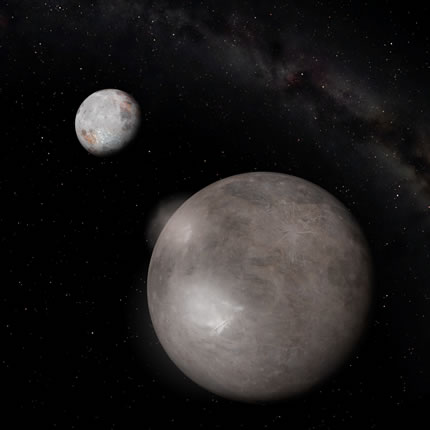
A few weeks ago I was working on a press release for Gemini Observatory about Charon. We got the graph above from the scientist who had done the observations, which were made using a special infrared-sensitive imager/spectrograph and adaptive optics at the Gemini North telescope on Mauna Kea, Hawai'i. It's an important piece of science, but we knew we needed a pretty picture to bring the story home to readers who don't know a lot about spectroscopy or infrared imaging. So, I worked on a mockup of what I thought Charon would look like if it had geyser-type formations spewing water ice across the surface. Planetary scientists have a term for this kind of action: cryovolcanism.
Even though this was the first time that cryovolcanism had been "seen" on Charon, I knew from past experience with other icy worlds (and comets) about what it should look like. Ultimately, using worlds created for Seeker3D by Software Bisque, a DigitalSky starfield from Sky-Skan, Inc. plus some Adobe Photoshop® wizardry by Mark Petersen (and a little additional Photoshop® work of my own), I created a composite scene of what I thought the Charon cryovolcanism action would look like, and sent it off to the folks at Gemini to use with the press release and subsequent story/caption.
An artist’s conception of Charon (with Pluto in the background) against the backdrop of the Milky Way. The plumes and brighter spots depicted at left on Charon are thought to be created as water (with some ammonia hydrate mixed in) “erupts” from deep beneath the surface. The material sprays out through cracks in the icy crust, immediately freezes and snows crystalline ice down onto the surface, creating a water-ammonia hydrate ice field. Such fields were detected and studied using the near-infrared imager on Gemini North. (This composite image includes Pluto and Charon models (enhanced), courtesy of Software Bisque. www.seeker3d.com, with plumes and ice fields added by Mark C. Petersen, Loch Ness Productions. Star field from DigitalSky 2, courtesy Sky-Skan, Inc.)
Coupled with the graphed data, the subsequent story (which you can read here) gives every kind of reader something to grasp in this story of exploration of our outer solar system.
Having gone through the process of image creation (along with the writing of the press release (with valuable input from astronomers Jason Cook, Scott Fisher, Steven Desch, and Tom Geballe)), I appreciated once again the power of the written word coupled with strong illustrations that tell both a scientific and visual story. Judging by the number of places that picked up the story and image and ran with it, I'd guess all of us who worked on this story succeeded in bringing that story home!
The Seven Wonders of the Universe Intelligent Life
When you stand out under a starry sky, it's inevitable that you see all those stars (and a few planets) and wonder about what OTHER intelligent life there is "out there." It's an interesting philosophical train of thought to get on because, if you're intellectually honest with yourself, you stumble across two compelling, but opposed realizations:
1. We could be the ONLY intelligent life in the cosmos; 2. We are NOT the only intelligent life in the cosmos.
Either way, those can be frightening, even challenging ideas to entertain. If we ARE the only intelligent life in the cosmos, then look around at our home planet and see how we're treating the only place we know we can exist. Think about how we treat each other, especially if we ARE the only INTELLIGENT life in the cosmos.
If we are NOT the only intelligent life in the cosmos, then that means there could be life that's more or less intelligent that we are. How do we measure up, especially when we examine how we treat our home and our fellow intelligent lifers?
I doubt most of us alive now will know if there IS intelligent life "out there" unless we start getting visited from other planets. But, there's intelligent life on our own planet, distinct from humans, and we don't have a good track record with it these days. That life exists underwater, in the oceans, with its own societies and ways of living. If our track record with dolphins, for example, is any indication, our first visitation with intelligences from elsewhere in the cosmos is going to be a rocky one.
So, think about it next time you're out stargazing. You've been blessed with intelligence that lets you comprehend and STUDY the sky, to understand the world around you. It's special, but how special is it?
The sites below belong to space and astronomy enthusiasts. I make every effort to check them and make sure they are still appropriate. However, I am not responsible for their content, nor do I endorse any of it by simply linking to them. As with all Web surfing, please exercise caution.
Adot's Notblog A fellow traveler blogger and astronomy enthusiast!
Astronomy Blog An astronomy blog pondering the big questions











 by Geoffrey Landis. It's a very scientific look at the very human enterprise of exploring Mars. The attention to detail gave me a few "I didn't know that" moments, such as the fact that due to the heavy